· Pet Grooming License & Business Requirements · 19 min read
Oregon Pet Grooming License Requirements (2025)
Step-by-step guide to starting a pet grooming business in Oregon. Covers permits, licensing, taxes, and compliance.

Pet Grooming License & Business Requirements in Oregon (2025): The Complete Guide
Important: Fees, tax rates, and regulations change frequently. This guide reflects requirements as of early 2025. Always verify current requirements with the specific agencies listed before making business decisions. Direct links to official sources are provided throughout.
Starting a pet grooming business in Oregon is legally straightforward—and operationally layered.
You’ll often hear:
“Oregon doesn’t require a pet groomer license.”
That statement is true, but it conceals the actual compliance work. Oregon regulates grooming as a business activity and animal facility, not as a licensed profession. The real requirements live in business registration, tax obligations, county animal facility permits, zoning approval, and sanitation standards—not in a professional grooming credential.
This guide covers storefront salons, home-based groomers, and mobile grooming operations, with specific attention to requirements most groomers discover too late—including Oregon’s unique tax structure with no sales tax but mandatory income taxes and potential Corporate Activity Tax.
Quick Reference: What You Must Do
Required for ALL Grooming Businesses (Regardless of Model)
- Oregon business registration (Secretary of State) - varies by structure
- Federal EIN (IRS)
- Oregon tax setup (income tax, and potentially Corporate Activity Tax if over $1M revenue)
- Business insurance (general liability, CCC/bailee coverage)
- Business banking account
Model-Specific Requirements
| Requirement | Storefront | Home-Based | Mobile |
|---|---|---|---|
| Zoning approval | Commercial zoning verification | Home occupation permit/approval | Parking/storage location approval |
| City business license | If city requires (varies by city) | If city requires (varies by city) | Each city you operate in |
| County animal facility permit | Usually required | Often required | Varies by county |
| Wastewater approval | Commercial sewer/septic | Septic system approval critical | Holding tank + disposal plan |
| Facility inspection | Yes | Depends on county | Depends on county |
| Building permits | Often required | Rarely | Vehicle modifications only |
Bottom line: Business registration and taxes apply to everyone. Zoning, county permits, and wastewater requirements vary dramatically by location and model.
If you’re setting up across the border in Washington, check out our comprehensive Washington grooming licensing requirements guide for state-specific differences in tax structure and permits.
Part 1: Do You Need a Pet Groomer License in Oregon?
The short answer
No. Oregon does not issue a professional license for pet groomers. Grooming is not regulated by any state licensing board that requires testing, certification, or continuing education.
There is:
- no state grooming board
- no state exam
- no mandatory professional certification
- no continuing education requirement
You can legally groom pets without a professional grooming license.
The important clarification
“No license required” does not mean “unregulated.”
Instead, Oregon regulates grooming businesses through:
- state business registration with the Secretary of State
- state and local income taxation (no sales tax)
- city and county business licensing
- county animal facility permits
- zoning and land-use controls
- facility sanitation and animal welfare standards
Most compliance failures happen because groomers stop researching after hearing “no license required.”
Part 2: Choose Your Business Model First (Everything Depends on This)
Before registering anything, decide how you will operate, because regulatory requirements change based on your model.
Common grooming business models
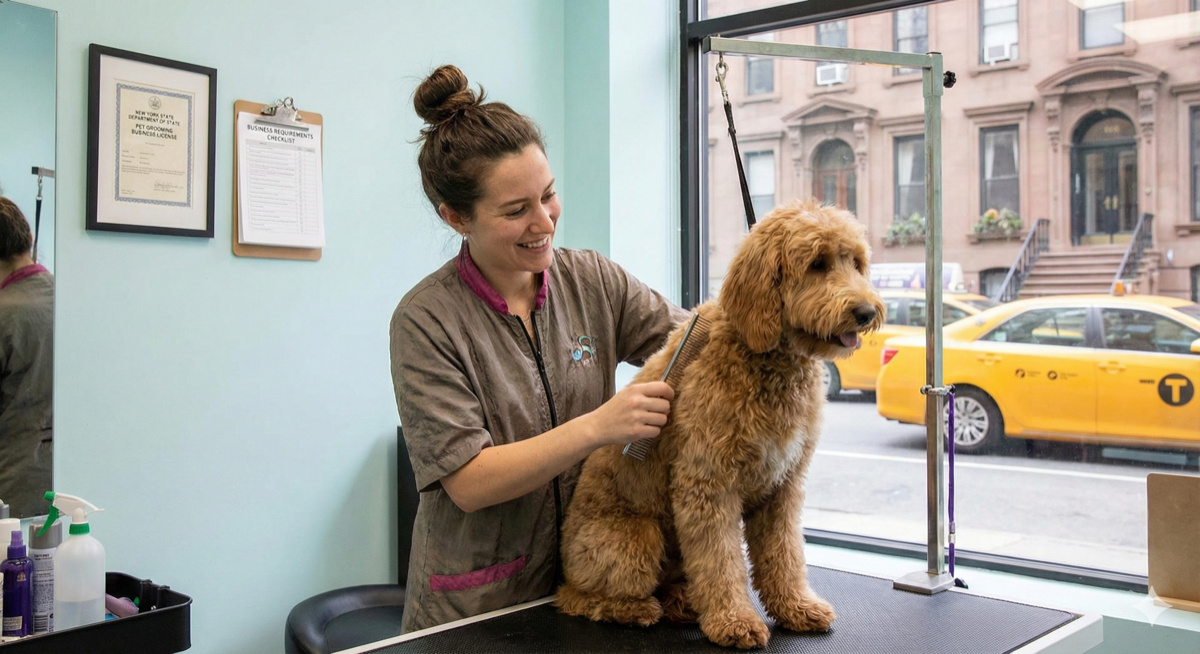
1. Storefront grooming salon
- Commercial lease or owned retail space
- Clients drop off and pick up pets
- Highest startup cost, most straightforward regulatory path
2. Home-based grooming
- Operates from a residence (garage, basement, converted room)
- Lower overhead
- Zoning and septic system constraints
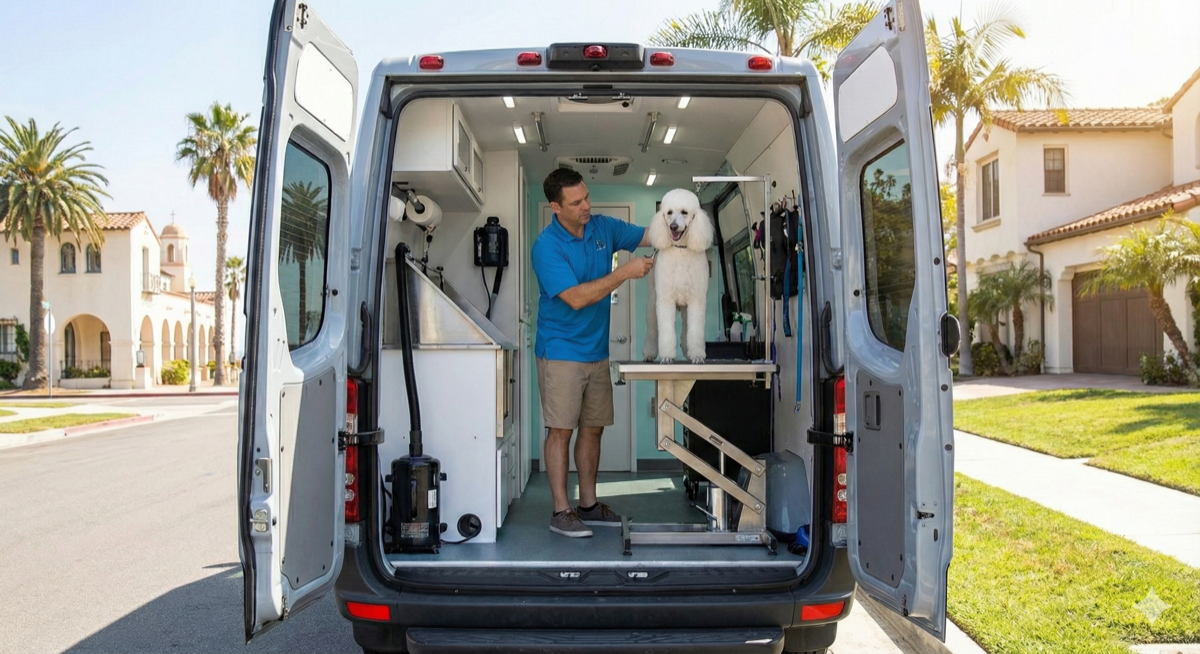
3. Mobile grooming
- Van or trailer-based grooming unit
- Travels to client locations
- Multi-jurisdiction licensing complexity
- Wastewater disposal critical
Once you select a model, every subsequent step—zoning, permits, inspections, and taxes—follows from it.
Part 3: Oregon Business Registration (Required for Most Groomers)
Most grooming businesses in Oregon must register with the Oregon Secretary of State.
Official resource: Oregon Secretary of State Business Registry | Phone: 503-986-2200
Who must register
Always required:
- LLCs and corporations
- Sole proprietors or partnerships using an assumed business name (DBA)
- Businesses with employees
May be exempt from state registration:
- Sole proprietors using only their legal name with no employees
However, even if exempt from state registration, you may still need city/county business licenses and must register for federal and state tax purposes.
What business registration does
Your registration:
- legally establishes your business entity with the state
- creates your business’s legal identity
- is required for tax accounts
- is needed for city and county permits
- is required for banking and insurance
Operating without proper registration means operating illegally.
Registration fees and renewal (verify current fees)
Current fees as of early 2025 (always verify at Oregon SOS Fee Schedule):
- LLC registration: $100 initial filing, $100 annual renewal
- Corporation registration: varies by type
- Assumed Business Name: $50 filing, renewal every two years
- Registration typically processed within days if filed online
Note: Fees are subject to change. Verify current amounts before filing.
Part 4: Taxes Groomers Must Pay in Oregon (No Sales Tax, But Complex Income Taxes)
Official resource: Oregon Department of Revenue | Phone: 503-378-4988
This is where Oregon differs dramatically from most states.
1. Oregon Has No Sales Tax
Oregon is one of five states with no sales tax.
This means:
- you do not charge sales tax to customers
- you do not collect or remit sales tax
- this is a significant competitive advantage
- pricing is simpler (no tax calculations at checkout)
However, Oregon makes up for this through higher income taxes.
2. Oregon Personal Income Tax (Pass-Through Entities)
For sole proprietors, partnerships, LLCs taxed as partnerships, and S corporations, business income passes through to your personal tax return.
Oregon’s graduated personal income tax rates (2024 tax year):
Note: These rates are subject to annual adjustment. Verify current brackets at Oregon Department of Revenue - Personal Income Tax.
- 4.75% on income up to $4,050 (single) / $8,100 (married)
- 6.75% on income $4,051-$10,200 (single) / $8,101-$20,400 (married)
- 8.75% on income $10,201-$125,000 (single) / $20,401-$250,000 (married)
- 9.9% on income over $125,000 (single) / $250,000 (married)
You pay quarterly estimated taxes to both Oregon and the IRS.
3. Oregon Corporate Excise Tax (C Corporations)
Official guidance: Oregon Corporate Taxes
If you operate as a C corporation, you pay Oregon Corporate Excise Tax.
Current rates (verify for current tax year):
- 6.6% on Oregon taxable income up to $1 million
- 7.6% on Oregon taxable income over $1 million
There is also a minimum tax based on Oregon sales:
- $150 (sales under $500,000)
- $500 (sales $500,000-$999,999)
- $1,000 (sales $1 million-$1.99 million)
- $1,500 (sales $2 million-$2.99 million)
- Scales up to $100,000 (sales $100 million+)
Even corporations with no net income pay the minimum tax.
4. Corporate Activity Tax (CAT) – Critical for Growing Businesses
Official guidance: Oregon Corporate Activity Tax
Implemented in 2020, Oregon’s Corporate Activity Tax applies to businesses with Oregon commercial activity exceeding $1 million (verify current threshold annually).
This is a gross receipts tax (not based on profit):
Current structure (verify for current tax year):
- $250 base + 0.57% on commercial activity over $1 million
- 35% subtraction allowed for greater of cost of goods sold or labor costs
- Quarterly estimated payments required if liability exceeds $5,000
- Annual return due April 15
CAT applies to:
- all business entities (sole proprietors, partnerships, LLCs, corporations)
- regardless of profitability
- based on gross receipts, not net income
Important: CAT rules are complex with apportionment formulas and specific deductions. Consult with a tax professional and review current Oregon DOR guidance.
Most small grooming businesses won’t hit the $1 million threshold initially, but this becomes relevant as you scale.
5. Employer Payroll Taxes (If You Have Employees)
Register through: Frances Online - Oregon’s Employer Portal
If you hire staff:
- Oregon unemployment insurance tax (rates vary by experience rating; new employers typically ~2.1%)
- State income tax withholding (based on employee’s Oregon W-4)
- Transit taxes in certain districts (Portland TriMet, Lane Transit, etc.)
- Federal payroll taxes (Social Security, Medicare, federal withholding)
Register for payroll taxes through Frances Online, Oregon’s employer portal.
Part 5: City Business Licensing (Highly Variable by Location)
Unlike many states with uniform requirements, Oregon city licensing is extremely decentralized.
Who needs city licenses
- storefront salons inside city limits
- home-based groomers inside city limits
- mobile groomers operating in city limits
City-by-city variation
Oregon has no statewide city license requirement. Each city sets its own rules.
Some cities have no business license requirement. Others require registration and annual fees or taxes.
Portland and Multnomah County (Special Case)
Official resource: City of Portland Revenue Division - Business Tax | Phone: 503-823-5157
Portland has a Business License Tax, which is actually an income tax:
- Register through City of Portland Revenue Division
- One registration covers both Portland and Multnomah County
- $100 minimum annual fee (verify current year)
- 2.6% tax on net income apportioned to Portland/Multnomah County (verify current rate)
- Exemption for businesses grossing under $50,000 from Multnomah County sources (for County tax portion)
- Metro Supportive Housing Services (SHS) tax may also apply
File annual return by April 15 (or your federal filing deadline).
Important: Portland and Multnomah County tax rates, minimums, and thresholds can change. Always verify current requirements at the official Portland Revenue Division website before filing.
Salem
Salem requires all businesses (home-based and commercial) to obtain a city business license:
- Annual license required
- Fee based on gross receipts
- Renewal required annually
- Application through city offices
Eugene
Eugene requires business registration:
- Different requirements for home-based vs. commercial operations
- Zoning approval required
- Fee structure varies
Bend, Gresham, Hillsboro
Each has its own business license or registration requirements. Always check with your specific city clerk or revenue office.
For cities without requirements
Many smaller Oregon cities have no business license requirement. Contact your city hall to confirm.
Part 6: County Animal Facility Licensing and Permits
While the state does not license groomers, counties often regulate grooming facilities.
Official rules: Oregon Administrative Rules (OAR 603-015-0025 through 0060) - View current rules
OAR 603-015-0025 defines “Grooming Parlor” as:
“Any establishment that bathes, clips, pedicures, or grooms any pet or captive animal for profit or compensation.”
Depending on your county and facility type, you may need:
- an animal facility license
- a grooming parlor permit
- facility inspections
- compliance with animal care standards
Critical: County requirements vary significantly. Contact your specific county animal services office to determine exact requirements, fees, and inspection procedures.
Part 7: County Examples (Requirements Vary Significantly)
Multnomah County
Official resource: Multnomah County Animal Services | Phone: 503-988-7387
Facility licensing: About Facility Licensing
Multnomah County Animal Services requires licensing for animal facilities, which includes grooming parlors.
Requirements:
- annual facility license
- facility inspection by Animal Services officer
- compliance with county ordinances (Multnomah County Code 13.150-13.1524)
- proof of insurance typically required
- facility must meet sanitation and animal welfare standards
Licenses issued after inspection confirms facility meets requirements.
Important: Land use approval is separate from facility licensing. Contact Multnomah County Land Use Planning (land.use.planning@multco.us | 503-988-3389) for zoning questions.
Action step: Contact Multnomah County Animal Services directly to confirm current licensing requirements, fees, and inspection procedures before starting operations.
Clackamas County
Clackamas County regulates animal facilities under its animal control regulations.
Requirements vary based on:
- facility type (storefront, home-based, mobile)
- number of animals on-site at once
- zoning district
Action step: Contact Clackamas County Dog Services directly to confirm specific permit requirements for your operation.
Washington County (Oregon)
Washington County Animal Services licenses animal-related businesses including grooming facilities.
Official resource: Washington County Animal Services | Phone: 503-846-7041
Requirements typically include:
- facility license application
- site inspection
- proof of rabies vaccination verification procedures
- compliance with facility standards
Action step: Contact Washington County Animal Services for current licensing requirements and fees.
Deschutes County
Deschutes County requires compliance with state animal facility standards but handles permits through the Community Development Department.
Official resource: Deschutes County Community Development | Phone: 541-388-6575
Requirements often involve:
- zoning approval
- building permits (if constructing or modifying space)
- onsite septic system approval (critical for home-based operations)
Action step: Contact Deschutes County Community Development for zoning and permit requirements. Contact their Onsite Wastewater Program for septic questions.
Lane County
Lane County regulates kennels and animal facilities.
Fees and requirements (verify current amounts):
- Non-commercial animal facilities: $150 annually
- Commercial facilities: $250 annually
- Inspection required
- Facility must meet care standards
Action step: Contact Lane County Animal Services for current requirements and application procedures.
Marion County
Marion County requires zoning approval and may require specific permits depending on:
- location (urban vs. rural zoning)
- number of animals
- whether facility is home-based or commercial
Conditional use permits may be required in residential zones.
Action step: Contact Marion County Planning Division and Animal Control to determine specific requirements for your proposed location.
Part 8: Zoning (The Requirement That Overrides Everything)
Zoning approval is mandatory before opening any grooming business.
Storefront zoning
You must confirm that:
- pet grooming is an allowed or conditional use in your zoning district
- parking requirements can be met
- signage is permitted
- noise and odor standards can be maintained
- wastewater disposal is approved
Contact your city or county planning department for zoning verification.
Home-based zoning (Home Occupation Rules)
Home occupation regulations vary dramatically by jurisdiction but often limit:
- number of client visits per day
- number of employees (often zero or one non-resident)
- animals on-site simultaneously (often 4-6 maximum)
- exterior business signage
- parking (often no commercial vehicle parking visible from street)
- noise levels
- hours of operation
- wastewater generation
Some jurisdictions effectively prohibit commercial grooming from residential zones due to wastewater restrictions.
Portland home occupation rules (Title 33.203):
- Type A: No employees or customers at site (consultants, remote work)
- Type B: Limited employees/customers allowed with restrictions
Grooming would typically require Type B approval if allowed at all.
Mobile grooming zoning
Zoning still applies to:
- where you park or store your mobile unit (home base)
- where you conduct administrative work
- wastewater disposal locations
Some residential zones prohibit parking commercial vehicles.
Part 9: Facility, Sanitation, and Wastewater Requirements
Facility standards: Oregon Administrative Rules (OAR 603-015-0025 through 0060) - View current rules
Wastewater regulations: Oregon DEQ - Onsite Wastewater Systems
Oregon Administrative Rules establish standards for animal facilities including grooming parlors.
Indoor facility requirements (OAR 603-015-0040)
Facilities must have:
- structural soundness (no injuries, proper containment)
- electric power and potable water supply
- adequate lighting (natural and artificial)
- isolation facilities for sick animals
- proper ventilation (temperatures 70-75°F recommended)
- impervious, cleanable flooring
- sanitary conditions maintained
Sanitation standards
Required practices:
- daily removal of excreta from enclosures
- weekly sanitization using safe, effective disinfectants
- clean, accessible water at least twice daily
- proper food storage and feeding practices
- isolation of sick animals
- premises kept free from trash
Professional grooming salon software with digital compliance tracking and vaccination management helps ensure you meet OAR 603-015 standards without manual checklists, keeping documentation audit-ready for county inspections.
Wastewater is critical
Grooming wastewater contains hair, chemicals, feces, urine, and cleaning agents.
This wastewater is different from residential wastewater and may not be appropriate for residential septic systems.
Official guidance: Oregon DEQ - About Septic Systems
Rules: Oregon DEQ - Onsite Wastewater Rules (OAR 340-071)
Home-based groomers on septic
Many jurisdictions restrict or prohibit commercial grooming wastewater from entering residential septic systems because:
- higher volumes than residential use
- chemical content (shampoos, disinfectants)
- biological load (feces, urine, hair)
- can overwhelm or damage septic system
You may be required to:
- upgrade to a commercial-rated septic system
- install a holding tank with commercial pumping service
- connect to municipal sewer (if available)
- obtain onsite wastewater permit modification from county
Action step: Contact your county’s On-Site Wastewater Program before starting home-based grooming. Do not assume your existing residential septic system is approved for commercial grooming wastewater.
Mobile groomers
Critical: Wastewater must be:
- captured in onboard holding tanks
- disposed of at approved dump stations or sanitary sewer connections
- never dumped into storm drains, streets, yards, or natural water bodies
Illegal wastewater disposal can result in:
- fines from Oregon Department of Environmental Quality (DEQ)
- criminal charges
- business closure
- environmental cleanup liability
Action step: Before starting operations, identify and map approved wastewater disposal locations (RV dump stations, wastewater treatment facilities that accept commercial haulers, or properties with approved septic/sewer connections where you have permission).
Part 10: Animal Welfare and Operating Standards
Legal framework: Oregon Revised Statutes (ORS 167.310-167.390) - Animal abuse and neglect laws apply to all animal businesses
Oregon expects groomers to follow humane handling practices:
- no unattended animals in unsafe conditions
- proper temperature control (heat stress prevention)
- secure containment
- immediate response to injuries or illness
- vaccination verification (especially rabies)
While not codified as grooming-specific regulations, animal cruelty and neglect laws (ORS 167.310-167.390) apply to all animal businesses.
Best practice: Document handling procedures and incident response protocols to demonstrate compliance with animal welfare standards.
Part 11: Insurance (Not Optional in Practice)
Most Oregon groomers need:
- general liability insurance
- care, custody, and control (CCC) coverage (also called bailee coverage)
- commercial property insurance
- commercial auto insurance (mobile groomers)
- workers’ compensation (if employees)
Many counties require proof of insurance to issue animal facility permits.
Typical liability coverage: $1-2 million.
Part 12: Home-Based vs Mobile vs Storefront — Key Differences
Home-based
- lowest overhead
- most zoning-sensitive
- septic system compliance critical
- client visit limitations
- neighbor complaint risk
Mobile
- multi-jurisdiction licensing (each city you serve)
- wastewater compliance absolutely mandatory
- commercial vehicle insurance required
- flexible location, higher operating costs
Storefront
- highest startup cost
- clearest zoning path
- easier client access
- higher lease/mortgage costs
- more straightforward permitting
Part 13: Example — Operating in Portland
Portland (Multnomah County) typically requires:
- Oregon business registration (Secretary of State)
- Portland/Multnomah County business tax registration
- Multnomah County animal facility license (if applicable)
- Zoning verification or home occupation permit
- Facility inspection
- Proof of insurance
Missing any layer can delay opening or result in closure and penalties.
Cost example:
- LLC registration: $100
- Annual renewal: $100
- Portland business tax: $100 minimum + 2.6% net income
- Multnomah County animal facility license: varies (contact Animal Services)
- Insurance: $500-1,500 annually
- Zoning/permits: varies
Part 14: Practical Compliance Checklist
Universal (all groomers)
- Oregon business registration (Secretary of State)
- Federal EIN (IRS)
- Oregon tax registration (corporate excise or personal income setup)
- Quarterly estimated tax payment system
- Business banking account
- Business insurance
Storefront
- Zoning approval confirmed
- City business license (if required in your city)
- County animal facility permit
- Building permits (if building out space)
- Wastewater/sewer approval
- Facility inspection passed
- Proof of insurance submitted
Home-based
- Home occupation zoning compliance verified
- Septic system approval for commercial use (or sewer connection)
- Animal count limits confirmed
- Client visit restrictions understood
- Parking regulations met
- Neighbor notification (if required)
- County animal facility permit (if required)
Mobile
- Commercial vehicle registration and insurance
- Wastewater holding tank and disposal plan
- City licenses for all jurisdictions where you operate
- County permits (if required)
- Parking/storage location zoning approval
- Proof of insurance
Part 15: Common Mistakes and How to Avoid Them
Mistake 1: Assuming no sales tax means no taxes
Oregon may not have sales tax, but income taxes are higher than most states. Budget for:
- quarterly estimated tax payments
- potential Corporate Activity Tax (if you exceed $1 million in revenue)
- city income taxes (Portland/Multnomah County)
Mistake 2: Starting home-based grooming without septic approval
Many home-based groomers discover after starting that their septic system cannot handle commercial grooming wastewater.
Result: expensive septic upgrades, holding tank installation, or forced closure.
Solution: Contact your county’s On-Site Wastewater Program before starting.
Mistake 3: Mobile groomers dumping wastewater illegally
Disposing of grooming wastewater down storm drains, in parking lots, or on the street is:
- illegal
- subject to DEQ enforcement
- grounds for business closure
- potentially criminal
Solution: Map approved dump stations and sanitary sewer connections before starting operations.
Mistake 4: Ignoring city-specific licensing
Operating in multiple cities as a mobile groomer without checking each city’s requirements can result in:
- penalties
- cease operations orders
- back taxes and fees
Solution: Contact each city where you regularly operate to confirm requirements.
Mistake 5: Not getting zoning approval first
Signing a lease or starting construction without zoning approval can result in:
- lease forfeiture
- construction stop orders
- inability to open
Solution: Get written zoning approval before signing leases or starting build-out.
Part 16: Licensing Timeline (How Long Does This Take?)
Important: These are general estimates. Actual timelines vary significantly by jurisdiction and depend heavily on permit backlogs, inspection schedules, and complexity of your specific situation. Always contact the relevant permitting authorities for current processing times.
Realistic timeline from decision to opening:
Storefront: 3-6 months
- Business registration: 1-2 weeks
- Zoning approval: 2-8 weeks (can be much longer if conditional use permit or variance required)
- Build-out and permits: 4-12 weeks
- Inspections and corrections: 2-4 weeks
- Final approvals: 1-2 weeks
Home-based: 1-3 months
- Business registration: 1-2 weeks
- Zoning/home occupation approval: 2-4 weeks
- Septic evaluation/approval: 2-6 weeks (often the longest step)
- Animal facility permit: 2-4 weeks
Mobile: 1-2 months
- Business registration: 1-2 weeks
- Vehicle outfitting: varies (often done before registration)
- City licenses: 1-4 weeks per jurisdiction
- Insurance and permits: 2-3 weeks
Critical path items that cause delays:
- Septic system approvals (home-based) - can extend timeline by months
- Zoning variances or conditional use permits - add 2-4 months
- Building permits and inspections - varies by city/county workload
- County animal facility inspections - depends on scheduling availability
Action step: Contact each relevant permitting authority at the start of your planning process to ask for current typical processing times.
Part 17: How to Verify Your Specific Requirements
Regulations change frequently and vary by jurisdiction. Use this checklist to verify current requirements for your specific situation:
State-level verification
- Business registration: Confirm current fees and filing requirements at Oregon Secretary of State | 503-986-2200
- Tax requirements: Verify current tax rates, thresholds, and filing requirements at Oregon Department of Revenue | 503-378-4988
- Wastewater rules: Review current onsite wastewater regulations at Oregon DEQ
County-level verification
- Animal facility permit: Contact your county animal services office directly to confirm:
- Whether grooming facilities require a permit in your county
- Current application process and fees
- Inspection requirements and timeline
- Insurance requirements
- Zoning approval: Contact your county planning/zoning department to confirm:
- Whether grooming is allowed in your proposed location
- Home occupation rules (if home-based)
- Parking, signage, and operational restrictions
- Septic/wastewater: Contact your county’s On-Site Wastewater Program (if not on municipal sewer) to confirm:
- Whether your existing septic system can handle commercial grooming wastewater
- What upgrades or permits are required
- Approval process and timeline
City-level verification
- City business license: Contact your city clerk or revenue office to confirm:
- Whether your city requires a business license
- Current fees and filing requirements
- Renewal schedule
- Any city-specific taxes (especially Portland/Multnomah County)
- City zoning: If within city limits, verify zoning with city planning department
- Multiple cities (mobile groomers): Verify requirements for each city where you’ll regularly operate
Insurance verification
- Contact commercial insurance providers to confirm required coverage types and amounts
- Verify with county/city whether proof of insurance is required for permits
Professional assistance
Consider consulting:
- Attorney: For business structure, contracts, and liability issues
- Accountant/CPA: For tax planning, especially CAT and multi-jurisdiction issues
- Insurance agent: For appropriate coverage types and amounts
- Septic professional: For wastewater system evaluation (home-based operations)
Part 18: Resources and Contacts
Part 18: Resources and Contacts
State-level
Oregon Secretary of State – Business Registry
- Website: sos.oregon.gov/business
- Phone: 503-986-2200
- Services: Business registration, annual reports, forms
- Business Xpress License Directory
Oregon Department of Revenue
- Website: oregon.gov/dor/programs/businesses
- Phone: 503-378-4988
- Services: Tax registration, returns, guidance
- Corporate Activity Tax
- Corporate Excise Tax
Oregon Department of Environmental Quality (DEQ)
Oregon Business Xpress
- Website: oregon4biz.com
- Services: License directory, startup guides, resources
Oregon Employment Department (Payroll/UI)
- Website: oregon.gov/employ/businesses
- Frances Online Portal
- Employer Tax Phone: 503-947-1484
County contacts
Multnomah County Animal Services
- Website: multcopets.org
- Phone: 503-988-7387
- Facility Licensing
Multnomah County Land Use Planning
- Email: land.use.planning@multco.us
- Phone: 503-988-3389
Clackamas County Dog Services
- Phone: 503-655-8628
- Services: Animal facility permits
Washington County Animal Services
- Website: washingtoncountyor.gov/animal-services
- Phone: 503-846-7041
- Services: Facility licensing
Deschutes County Community Development
- Website: deschutes.org/cd
- Phone: 541-388-6575
- Services: Zoning, permits, septic
- Onsite Wastewater Program
Lane County Animal Services
- Contact county for current phone and website
- Services: Animal facility licensing
Marion County Planning
- Contact county for current phone and website
- Services: Zoning, conditional use permits
City contacts
City of Portland Revenue Division
- Website: portland.gov/revenue/business-tax
- Phone: 503-823-5157
- Services: Business tax registration and returns
City of Salem
- Website: cityofsalem.net
- Phone: 503-588-6178
- Services: Business license information
City of Eugene Planning & Development
- Website: eugene-or.gov
- Phone: 541-682-5377
- Services: Zoning, permits
City of Bend
- Contact city for current requirements
City of Gresham
- Contact city for current requirements
City of Hillsboro
- Contact city for current requirements
Legal references
Oregon Administrative Rules (OAR)
Oregon Revised Statutes (ORS)
Final Reality Check
Oregon makes it easy to start grooming—there’s no professional license barrier.
But Oregon also makes it easy to accidentally operate out of compliance.
There is no groomer license—but there are:
- business registration requirements
- income taxes (no sales tax, but higher income taxes)
- potential Corporate Activity Tax (verify current threshold)
- city business licenses (varies by jurisdiction - confirm locally)
- county animal facility permits (check with your specific county)
- zoning approval (often the hardest hurdle - verify before signing leases)
- wastewater disposal regulations (critical for home-based and mobile)
- facility sanitation standards (OAR 603-015)
If you approach setup in order—business registration → tax setup → zoning approval → permits → inspections—you avoid expensive corrections later.
Compliance protects:
- your business from closure and penalties
- your clients from liability and quality issues
- the animals in your care
And it keeps you operating legally and sustainably.
Take the Next Step
Once you’ve navigated Oregon’s licensing requirements and are ready to operate, professional grooming salon software built for Oregon groomers helps you manage the operational side—scheduling, client records, digital agreements, and compliance tracking—so you can focus on grooming instead of paperwork.
Start your free trial today and see how Packyard handles vaccination tracking, digital waivers, appointment management, and client communication in one platform.
Critical Reminder: Verify Everything Locally
This guide provides general framework only. Requirements, fees, rates, and procedures change frequently and vary significantly by jurisdiction.
Before making any business decisions:
- Contact the Oregon Secretary of State for current business registration fees and requirements
- Contact the Oregon Department of Revenue for current tax rates and thresholds
- Contact your specific county animal services office for facility permit requirements
- Contact your specific city for business license and tax requirements
- Contact your county planning/zoning department for zoning verification
- Contact your county’s On-Site Wastewater Program if on septic system
- Verify all information at the official sources linked in Part 18
Do not rely solely on this guide. Use it as a starting point for your research, then verify every detail with the relevant authorities before proceeding.
This article is informational and not legal advice. Always confirm requirements with your city, county, the Oregon Secretary of State, and the Oregon Department of Revenue before opening. Regulations, fees, and requirements change frequently—verify current information with official sources.