· Pet Grooming License & Business Requirements · 16 min read
Pet Grooming License & Business Requirements in Florida (2025)
A comprehensive guide to starting a pet grooming business in Florida covering no state professional license requirement, no state income tax advantage, county business tax receipts, sales tax exemptions, LLC formation through Sunbiz, and county-specific requirements for Miami-Dade, Broward, Palm Beach, Orange, Hillsborough, and Duval counties.

Pet Grooming License & Business Requirements in Florida (2025): The Complete Guide
Starting a pet grooming business in Florida offers significant advantages over many other states.
You’ll often hear:
“Florida doesn’t require a pet groomer license, and there’s no state income tax.”
Both statements are true. Florida is one of the most business-friendly states for pet groomers. However, “no state license required” does not mean “unregulated.”
Florida regulates grooming as a business activity through county business tax receipts, local permits, and zoning—not through professional licensing. Understanding this distinction is critical to operating legally.
This guide covers storefront salons, home-based groomers, and mobile grooming businesses, with specific attention to Florida’s unique tax advantages, county-by-county requirements, and the recent home-based business legislation that benefits groomers.
Quick Reference: What You Must Do
Required for ALL Grooming Businesses (Regardless of Model)
- Business structure registration through Florida Division of Corporations (Sunbiz)
- Federal EIN from the IRS
- County Business Tax Receipt (in most counties)
- Business insurance (general liability, animal bailee coverage)
- Business banking account
Model-Specific Requirements
| Requirement | Storefront | Home-Based | Mobile |
|---|---|---|---|
| Zoning approval | Commercial zoning verification | Protected under FL Statute 559.955 with conditions | Vehicle storage location approval |
| City business tax receipt | If city requires (varies by city) | If city requires (varies by city) | Each city you operate in |
| County business tax receipt | Required in most counties | Required in most counties | May need multiple counties |
| County animal services permit | Varies by county | Varies by county | Varies by county |
| Wastewater approval | Commercial sewer connection | Typically existing residential | Holding tank + proper disposal |
| Sales tax registration | Only if selling retail products | Only if selling retail products | Only if selling retail products |
Bottom line: Business registration applies to everyone. The major Florida advantage is no state income tax and no sales tax on grooming services—but county requirements still apply and vary significantly.
Part 1: Do You Need a Pet Groomer License in Florida?
The short answer
No. Florida does not issue a professional license for pet groomers. Grooming is not regulated by the Florida Department of Business and Professional Regulation or any state licensing board.
There is:
- no state grooming board
- no state exam
- no mandatory certification
- no continuing education requirement
You can legally groom pets without a professional grooming license.
The important clarification
“No license required” does not mean “unregulated.”
Florida regulates grooming businesses through:
- state business entity registration (through Sunbiz)
- county business tax receipts (local business licenses)
- county animal services permits (varies by county)
- zoning and land-use controls
- local facility and sanitation standards
Most compliance issues arise because groomers assume “no license” means no paperwork. The regulatory burden in Florida is lighter than many states, but it still exists at the county and municipal level.
Part 2: Choose Your Business Model First (Everything Depends on This)
Before registering anything, decide how you will operate, because regulatory requirements change based on your model.
Common grooming business models
1. Storefront grooming salon
- Commercial lease or owned retail space
- Clients drop off and pick up pets
- Highest startup cost, most straightforward permitting
- Subject to commercial zoning requirements
2. Home-based grooming
- Operates from a residence
- Lower overhead
- Protected under Florida Statute 559.955 (Home-Based Business law)
- Still subject to some limitations and HOA restrictions
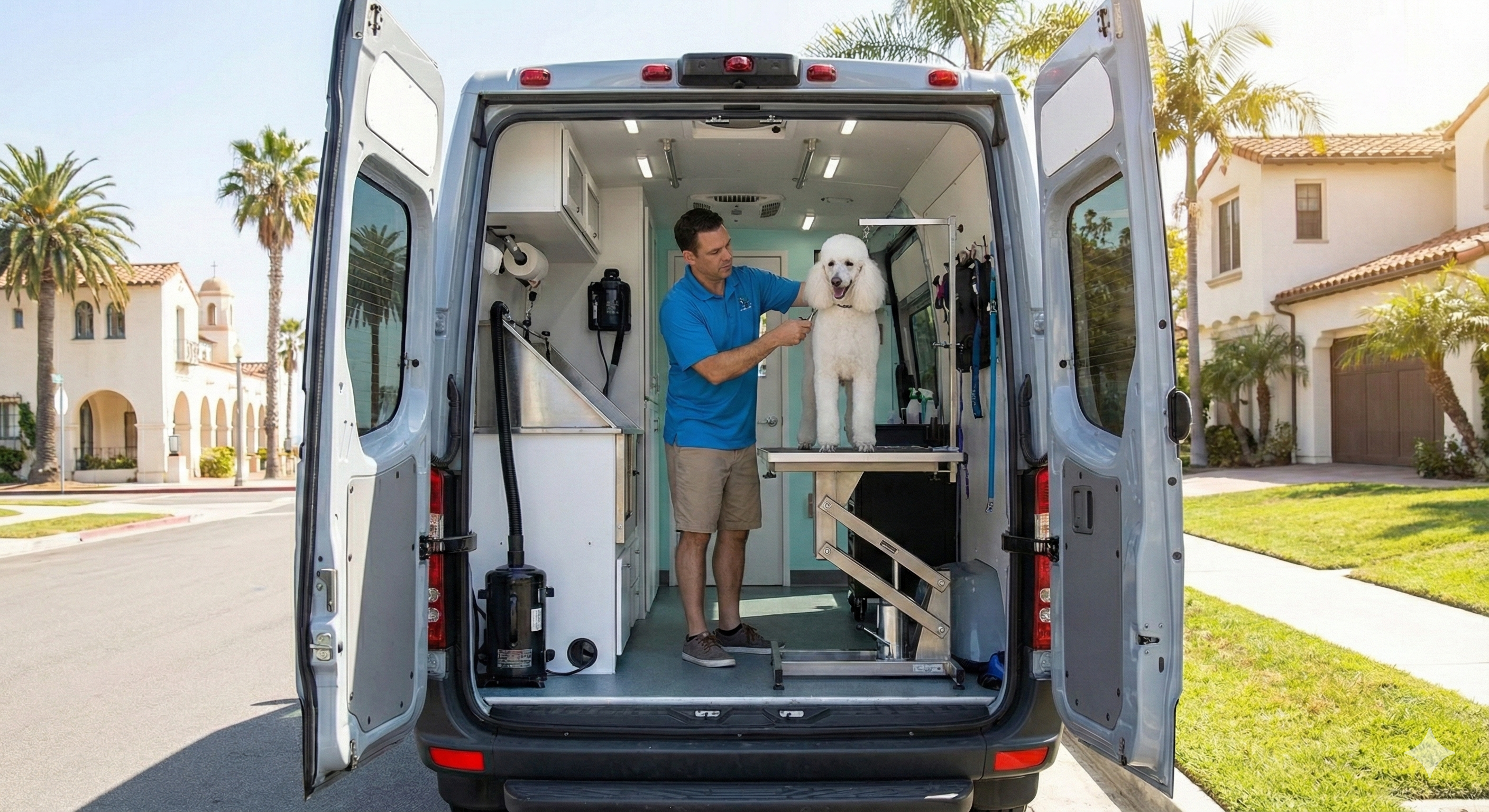
3. Mobile grooming
- Van or trailer-based grooming unit
- Travels to client locations
- Multi-county business tax receipt complexity possible
- Wastewater disposal is critical in Florida’s environmental context
Once you select a model, every subsequent step—zoning, permits, taxes—follows from it.
Part 3: Florida Business Structure and Registration
Florida business registration happens through the Florida Division of Corporations, commonly known as Sunbiz.
Sole Proprietorship
A sole proprietorship requires no filing with the Florida Division of Corporations if you operate under your legal name. However:
- If you use a business name other than your legal name, you must file a Fictitious Name Registration with Sunbiz
- You must register for applicable local taxes
- You are personally liable for all business debts and obligations
Limited Liability Company (LLC)
An LLC provides liability protection and is the most popular structure for small grooming businesses.
Formation requirements:
- Filing: Submit Articles of Organization through Sunbiz
- Filing fee: $125 ($100 for Articles of Organization + $25 registered agent designation fee)
- Processing time: 1-5 business days for online filing
- Annual Report: $138.75, due between January 1 and May 1 each year
- Late fee: $400 if filed after May 1
Important dates:
- Annual reports are due by May 1 each year
- If not filed by the third Friday of September, your LLC will be administratively dissolved on the fourth Friday of September
- Your first annual report is due the year after your LLC is formed
Corporation
Corporations (C-Corp or S-Corp) are less common for small grooming businesses but offer certain advantages for specific situations.
- Filing fee: Varies by type (check Sunbiz fee schedule)
- Annual Report: $150 for corporations
- Corporate income tax: 5.5% on taxable income over $50,000 (C-Corps only)
Part 4: Fictitious Name (DBA) Registration
If you operate under any name other than your legal name (for sole proprietors) or your exact registered entity name (for LLCs/corporations), you must file a Fictitious Name Registration.
Requirements
- Filing location: Florida Division of Corporations (Sunbiz)
- Filing fee: $50
- Duration: Valid for 5 years, expires December 31 of the final year
- Renewal: Between July 1 and December 31 of the expiration year
- Publication requirement: Must advertise the name once in a newspaper in your county (Chapter 50, Florida Statutes), but proof is not required—you certify compliance when signing the application
Example
If your name is Jane Smith and you want to operate as “Pawsome Grooming Studio,” you need a Fictitious Name Registration. If you form “Pawsome Grooming Studio LLC” with Sunbiz, you do not need a separate fictitious name registration for that exact name.
Part 5: Taxes for Pet Groomers in Florida (The Big Advantage)
Florida’s tax structure is one of its biggest advantages for small business owners.
1. No State Personal Income Tax
Florida is one of seven states with no state personal income tax.
This means:
- Sole proprietors and pass-through entity owners (LLC members, S-Corp shareholders) pay no Florida income tax on business profits
- You only pay federal income tax on business income
- This can represent significant savings compared to states like California (up to 13.3%) or New York (up to 10.9%)
2. Corporate Income Tax (C Corporations Only)
If you operate as a C Corporation:
- Rate: 5.5% on Florida taxable income over $50,000
- Exemption: First $50,000 of taxable income is exempt
- Filing: Annual return required even if no tax is due
Most small grooming businesses operate as sole proprietorships or LLCs and avoid this tax entirely.
3. Sales Tax — Grooming Services Are NOT Taxable
This is critical and often misunderstood.
Pet grooming services in Florida are NOT subject to sales tax. According to Florida Statute 212.08(7)(v) and Florida Administrative Code Rule 12A-1.0215:
Pet grooming services are considered professional services and as such, are exempt from sales tax. Pet grooming providers are the consumers of the tangible personal property they use in rendering such services.
What this means in practice
| Activity | Taxable? |
|---|---|
| Grooming service fees (bath, haircut, nail trim) | NO |
| Boarding charges | NO |
| Retail product sales (shampoo, brushes, treats sold to customers) | YES |
| Supplies you purchase for your business | YES (you pay, not your customer) |
If you sell retail products
If you sell any retail products to customers (beyond items incidental to grooming services), you must:
- Register for a Sales Tax Certificate with the Florida Department of Revenue
- Collect sales tax at the combined state + county rate (6% state + 0-2.5% county surtax = 6% to 8.5% depending on county)
- File regular sales tax returns and remit collected tax
If you provide grooming services only and do not sell retail products, you do not need to register for sales tax collection.
Part 6: County Business Tax Receipts (Local Business Licenses)
Florida does not have a statewide business license. Instead, most counties require a Local Business Tax Receipt (formerly called an “occupational license”) under Florida Statute Chapter 205.
Who needs a business tax receipt
- Storefront salons
- Home-based groomers (in most counties)
- Mobile groomers (potentially in multiple counties)
Key points
- Location-based: You need a receipt from the county (and often the city) where your business operates
- Fee structure: Varies by county and business type—typically $30 to $200+ annually
- Renewal period: Most run October 1 through September 30
- Delinquency: Receipts become delinquent October 1 if not renewed, with penalties up to 25%
- Display requirement: Must be displayed at your place of business
City AND County Requirements
If your business is located within city limits, you typically need both:
- A city business tax receipt (from the city)
- A county business tax receipt (from the county tax collector)
The city receipt usually must be obtained first before the county will issue theirs.
Part 7: County Animal Services Permits
Unlike many states, Florida does not have uniform statewide animal facility regulations for grooming. Requirements vary significantly by county.
Miami-Dade County — Recent Changes
Important update: In light of recent state legislation, Miami-Dade County Animal Services no longer requires licenses for pet care centers, mobile groomers, kennels, or pet dealers.
However, Animal Services still maintains applicable standards under Chapter 5 of the Miami-Dade County Code. They offer a voluntary certification program (Certificate of Acknowledgement) to help businesses remain compliant with code requirements.
Standards still apply:
- Records must be maintained for all animals on premises
- Medical emergency release forms required from pet owners
- Grooming equipment must be disinfected after each animal
Palm Beach County — Permits Required
Palm Beach County Animal Care and Control requires operational permits:
- Grooming Parlor (stationary): $400 annual permit fee, requires zoning approval
- Mobile Groomer: $225 annual permit fee
- Proof of business tax receipt required with application
Other Counties
Requirements vary. Contact your specific county’s animal services division to confirm current permit requirements before starting operations.
Part 8: Zoning — Florida’s Home-Based Business Advantage
Florida passed House Bill 403 in 2021, now codified as Florida Statute 559.955, which significantly benefits home-based businesses including pet groomers.
What the law provides
A home-based business may operate in an area zoned for residential use and cannot be treated differently from other businesses, provided it meets certain conditions.
Conditions for home-based grooming operations
Under Florida law, home-based businesses must:
- Have no more than two non-resident employees or independent contractors
- Not generate unreasonable traffic, parking, or noise
- Not use vehicles or equipment inconsistent with residential use
- Operate within residential noise, parking, and nuisance standards
Local governments cannot:
- Impose restrictions on home-based business hours between 9:00 AM and 6:00 PM
- Create regulations that vary from town to town and disproportionately affect home-based businesses
- Treat home-based businesses differently from other businesses in their jurisdiction
Important limitation: HOAs
Florida Statute 559.955 does not override homeowners association (HOA) or condominium association rules. If your HOA’s declaration restricts commercial activity or home-based businesses, those restrictions remain enforceable.
Action step: Check your HOA rules before assuming you can operate from home.
Storefront zoning
Commercial retail space is generally the simplest path. Verify that:
- Pet grooming is a permitted use in the zoning district
- Parking requirements can be met
- Signage is permitted
Mobile grooming zoning
Zoning still applies to:
- Where you park or store your mobile unit (home base)
- Whether commercial vehicles are allowed in your residential area
- Your registered business address
Part 9: Wastewater and Environmental Compliance
Florida’s environmental regulations are administered by the Florida Department of Environmental Protection (DEP).
Key rule
Grooming wastewater must go to the sanitary sewer system, never the storm drain.
Storm drains in Florida flow directly to waterways—rivers, lakes, canals, and eventually the ocean—without treatment. Grooming wastewater contains hair, chemicals, and biological matter that can harm Florida’s sensitive aquatic ecosystems.
Storefront operations
Commercial spaces typically have proper sewer connections. Verify with your landlord and local utility.
Home-based operations
- Wastewater from indoor grooming activities generally goes through standard residential plumbing to sanitary sewer
- If on septic, verify with your county that your system can handle the additional commercial load
- Some counties may restrict commercial wastewater discharge to residential septic systems
Mobile grooming — Critical compliance area
Mobile groomers must:
- Capture all wastewater in holding tanks
- Dispose of wastewater properly at approved facilities
- Never dump into storm drains, parking lots, streets, or yards
Florida DEP takes illegal wastewater disposal seriously. Violations can result in significant fines and potential criminal charges.
Resources:
Part 10: Animal Welfare and Operating Standards
Florida does not have specific statewide grooming standards like some states. However, animal welfare is protected under Florida Statute Chapter 828 (Cruelty to Animals).
General requirements
- Humane handling of all animals
- Adequate ventilation and temperature control (critical in Florida’s heat)
- Secure containment—no unattended animals in unsafe conditions
- Fresh water available
- Immediate response to injuries or illness
Vaccination requirements
Florida law (Florida Statute 828.30) requires rabies vaccination for all dogs, cats, and ferrets over four months of age. While not all groomers require proof of vaccination, it is standard industry practice and reduces liability.
County-specific standards
Counties with animal facility permits (like Palm Beach) may impose additional operational standards. Always check local requirements.
Part 11: Insurance (Not Optional in Practice)
Insurance is not legally required in most cases, but operating without it is reckless.
Essential coverages
- General liability: Covers injuries to clients or damage to their property at your location
- Care, custody, and control (CCC) / Animal bailee coverage: Covers injuries to pets in your care—standard homeowners and renters policies exclude this
- Professional liability: Covers claims of negligence in grooming services
- Commercial auto (mobile groomers): Covers vehicle accidents during business operations
- Property/equipment coverage: Covers grooming tools, supplies, and equipment
- Workers’ compensation (if hiring employees): Required by Florida law if you have 4+ employees, or 1+ employees in construction
Home-based groomer warning
Homeowners insurance typically excludes business activities. If a pet is injured during grooming at your home, your homeowners policy almost certainly won’t cover it. You need separate business insurance or a business rider.
Part 12: Home-Based vs Mobile vs Storefront — Key Differences
Home-based
Advantages:
- Lowest overhead and startup cost
- Protected under Florida Statute 559.955
- No commercial lease
Challenges:
- HOA restrictions may apply
- Limited to 2 non-resident employees
- Must meet residential noise and parking standards
- May still need county animal facility permit
Mobile
Advantages:
- Flexibility in location
- No commercial lease
- Convenience for customers
Challenges:
- Wastewater capture and disposal required
- May need business tax receipts in multiple counties
- Commercial auto insurance required
- Vehicle maintenance and fuel costs
- Vehicle storage location must comply with zoning
Storefront
Advantages:
- Professional appearance
- No residential zoning concerns
- Can accommodate more staff and clients
- Easier to display business tax receipt publicly
Challenges:
- Highest startup and ongoing costs
- Commercial lease obligations
- May require more extensive permitting
Part 13: Regional Examples — Why Local Research Matters
Miami-Dade County
Official resources:
Requirements:
- Florida business entity registration (Sunbiz)
- City business tax receipt (if within a municipality)
- Miami-Dade County business tax receipt
- Animal services license no longer required, but must comply with Chapter 5 standards
- Voluntary Certificate of Acknowledgement available
Broward County
Official resources:
Requirements:
- Florida business entity registration (Sunbiz)
- City business tax receipt (if within a municipality)
- Broward County business tax receipt
- Local zoning compliance
- Check with specific municipality for any additional permits
Palm Beach County
Official resources:
Requirements:
- Florida business entity registration (Sunbiz)
- City business tax receipt (if within a municipality)
- Palm Beach County business tax receipt
- Animal Care and Control permit required:
- Grooming Parlor: $400/year
- Mobile Groomer: $225/year
- Zoning approval (city or county depending on location)
Orange County (Orlando Area)
Official resources:
Requirements:
- Florida business entity registration (Sunbiz)
- City business tax receipt first (if within Orlando, Ocoee, Winter Park, etc.)
- Orange County business tax receipt (applied through Fast Track system)
- Zoning verification through Orange County at (407) 836-3111
Hillsborough County (Tampa Area)
Official resources:
- Hillsborough County Tax Collector - Business Tax
- City of Tampa Business Tax
- Hillsborough County Startup Guide
Requirements:
- Florida business entity registration (Sunbiz)
- City business tax receipt (if within Tampa, call 813-274-8751 for appointment)
- Hillsborough County business tax receipt (through BTExpress)
- Zoning compliance verification
Duval County (Jacksonville)
Official resources:
Requirements:
- Florida business entity registration (Sunbiz)
- Certificate of Use (COU) from City of Jacksonville Zoning - $112 fee
- Local business tax receipt from Duval County Tax Collector
- No general business license required beyond these
Note: Jacksonville/Duval County uses a Certificate of Use system rather than traditional business licensing.
Part 14: Practical Compliance Checklist
Universal (All Groomers)
- Choose business structure (sole proprietorship, LLC, corporation)
- Register with Florida Division of Corporations (Sunbiz) if LLC or corporation
- File Fictitious Name Registration if using a trade name
- Obtain Federal EIN from IRS
- Obtain county business tax receipt
- Obtain city business tax receipt (if within city limits)
- Check county animal services permit requirements
- Secure business insurance (general liability, CCC/bailee coverage)
- Set up business banking account
- Register with Florida Department of Revenue (only if selling retail products)
Storefront
- Verify zoning permits commercial pet grooming
- Obtain building permits if doing construction/renovation
- Confirm wastewater/sewer connection
- Fire department inspection if required
- Display business tax receipt prominently
Home-based
- Verify compliance with Florida Statute 559.955 conditions
- Check HOA rules and restrictions
- Confirm fewer than 2 non-resident employees
- Verify parking and noise won’t exceed residential standards
- Check county animal services permit requirements
- Update insurance (business rider or separate policy)
Mobile
- Commercial auto insurance
- Wastewater holding tank system
- Map approved wastewater disposal locations
- Business tax receipts for counties where you operate
- Vehicle storage location zoning compliance
- County animal facility permits if required
Part 15: Key Florida Taxes Summary
| Tax | Who Pays | Amount | When Due |
|---|---|---|---|
| State Personal Income Tax | N/A | $0 (Florida has no state income tax) | N/A |
| LLC Annual Report | All Florida LLCs | $138.75/year | January 1 - May 1 |
| Corporate Income Tax | C Corporations only | 5.5% on income over $50,000 | Annual |
| Sales Tax on Grooming Services | N/A | $0 (services exempt) | N/A |
| Sales Tax on Retail Product Sales | Groomers selling products | 6% + county surtax (0-2.5%) | Monthly/Quarterly |
| County Business Tax Receipt | Most groomers | $30-$200+ (varies by county) | October 1 - September 30 |
| Self-Employment Tax (Federal) | All self-employed | 15.3% (Social Security + Medicare) | Quarterly estimated |
| Federal Income Tax | All | Progressive rates | Quarterly estimated + annual |
Part 16: Florida’s Key Advantages for Pet Groomers
1. No State Income Tax
Florida is one of seven states with no personal income tax. This can save a grooming business owner thousands of dollars annually compared to high-tax states.
2. No Sales Tax on Grooming Services
Unlike some states that tax services, Florida exempts pet grooming services from sales tax entirely.
3. Business-Friendly Home-Based Business Law
Florida Statute 559.955 protects home-based businesses from overly restrictive local zoning, making it easier to start a grooming business from home.
4. Relatively Simple LLC Formation
- $125 total to form an LLC
- Quick online processing (1-5 business days)
- No requirement for an operating agreement to be filed
- No publication requirement
5. No Franchise Tax
Unlike California ($800/year minimum) or other states, Florida has no franchise tax for LLCs. The annual report fee of $138.75 is among the more reasonable in the nation.
Part 17: Resources and Contacts
State-Level Resources
Florida Division of Corporations (Sunbiz)
- Website: dos.fl.gov/sunbiz
- LLC Formation: Start Business
- Fees: Fee Schedule
- Phone: (850) 245-6052
Florida Department of Revenue
- Website: floridarevenue.com
- Sales Tax Registration: Registration Portal
- Phone: (850) 488-6800
Florida Department of Environmental Protection
- Website: floridadep.gov
- Wastewater Information: Wastewater in Florida
- Onsite Sewage: Onsite Sewage Program
Florida Department of Business and Professional Regulation
- Website: myfloridalicense.com
- Note: Pet grooming is not licensed by DBPR, but useful for general business resources
County Tax Collector Offices
Miami-Dade County
Broward County
Palm Beach County
Orange County
Hillsborough County
Duval County (Jacksonville)
- Phone: (904) 255-5700
- Located at 231 East Forsyth Street, Jacksonville, FL
Industry Associations
Florida Pet Services Association
- flpetassociation.org
- Resources for navigating Florida pet business requirements
National Dog Groomers Association of America (NDGAA)
- nationaldoggroomers.com
- Professional certification programs
International Professional Groomers (IPG)
- ipgroom.com
- Certification and continuing education
Final Reality Check
Florida makes it easier than most states to start a pet grooming business.
There is no groomer license—and there is:
- No state income tax on business profits
- No sales tax on grooming services
- No franchise tax for LLCs
- State-level protection for home-based businesses
But Florida still requires:
- Business entity registration (Sunbiz)
- County business tax receipts
- County animal services permits (varies by county)
- Zoning compliance (protected for home-based but not unlimited)
- Wastewater compliance (especially for mobile groomers)
The regulatory landscape varies by county. A groomer in Miami-Dade faces different requirements than one in Palm Beach or Hillsborough County.
If you approach setup in order—business structure → county/city permits → zoning → insurance—you avoid expensive corrections later.
Florida’s business-friendly environment is real, but “easy” doesn’t mean “no paperwork.” Take advantage of the tax benefits while ensuring you’re compliant at the local level.
Take the Next Step
Once you’ve navigated Florida’s requirements and are ready to operate, professional grooming salon software built for Florida groomers helps you manage the operational side—scheduling, client records, digital agreements, and compliance tracking—so you can focus on grooming instead of paperwork.
Start your free trial today and see how Packyard handles vaccination tracking, digital waivers, appointment management, and client communication in one platform.
This article is informational and not legal or tax advice. Always confirm requirements with your city, county, the Florida Division of Corporations (Sunbiz), and the Florida Department of Revenue before opening. Regulations, fees, and requirements change—verify current information with official sources.