· Pet Grooming License & Business Requirements · 23 min read
Illinois Pet Grooming License Requirements (2026)
Step-by-step guide to starting a pet grooming business in Illinois. Covers permits, licensing, taxes, and compliance.

Pet Grooming License & Business Requirements in Illinois (2026): The Complete Guide
Important: Fees, tax rates, and regulations change frequently. This guide reflects requirements as of early 2026. Always verify current requirements with the specific agencies listed before making business decisions. Direct links to official sources are provided throughout.
Starting a pet grooming business in Illinois is accessible—but the regulatory landscape varies dramatically depending on where you operate.
You’ll often hear:
“Illinois doesn’t require a pet groomer license.”
That statement is true, but it hides the actual compliance work. Illinois regulates grooming as a business activity, not as a licensed profession. The real requirements live in business registration, state and local taxes, city licensing (especially in Chicago), zoning approval, and insurance—not in a professional grooming credential.
This guide covers storefront salons, home-based groomers, and mobile grooming operations, with specific attention to requirements most groomers discover too late—including Chicago’s prohibition on home-based animal care businesses and Illinois’s flat income tax structure.
Quick Reference: What You Must Do
Required for ALL Grooming Businesses (Regardless of Model)
- Illinois business registration (Secretary of State) - varies by structure
- Federal EIN (IRS)
- Illinois tax registration (income tax, sales tax on product sales)
- Business insurance (general liability, CCC/bailee coverage)
- Workers’ compensation insurance (mandatory with even one employee)
- Business banking account
Model-Specific Requirements
| Requirement | Storefront | Home-Based | Mobile |
|---|---|---|---|
| Zoning approval | Commercial zoning verification | Home occupation permit (prohibited in Chicago) | Parking/storage location approval |
| City business license | Required in most municipalities | Required in most municipalities | Each city you operate in |
| Chicago Animal Care License | Required ($275/two years) | Prohibited from home in Chicago | May be required |
| Wastewater approval | Commercial sewer connection | Septic system review if applicable | Holding tank + disposal plan |
| Building permits | Often required for build-out | Rarely (plumbing modifications only) | Vehicle modifications only |
| Workers’ comp insurance | Mandatory with any employees | Mandatory with any employees | Mandatory with any employees |
Bottom line: Business registration and taxes apply to everyone. Zoning, city licenses, and facility requirements vary dramatically by location and model—especially between Chicago and the suburbs.
If you’re considering operating in a neighboring state, check out our comprehensive Oregon grooming licensing requirements guide or Washington state guide for state-specific differences.
Part 1: Do You Need a Pet Groomer License in Illinois?
The short answer
No. Illinois does not issue a professional license for pet groomers. Grooming is not regulated by any state licensing board that requires testing, certification, or continuing education.
There is:
- no state grooming board
- no state exam
- no mandatory professional certification
- no continuing education requirement
You can legally groom pets without a professional grooming license.
The important clarification
“No license required” does not mean “unregulated.”
Instead, Illinois regulates grooming businesses through:
- state business registration with the Secretary of State
- state income tax (flat 4.95%) and sales tax on product sales
- city and municipal business licensing
- Chicago-specific Animal Care License requirements
- zoning and land-use controls
- mandatory workers’ compensation insurance for employers
- facility standards and animal welfare laws
Most compliance failures happen because groomers stop researching after hearing “no license required.”
Voluntary certifications
While not legally required, these certifications strengthen credibility and may lower insurance premiums:
- National Dog Groomers Association of America (NDGAA) - certification exams
- International Professional Groomers (IPG) - certification programs
- International Society of Canine Cosmetologists (ISCC) - certification
- Illinois Professional Pet Groomers Association (IPPGA) - voluntary standards and guidelines
Part 2: Choose Your Business Model First (Everything Depends on This)
Before registering anything, decide how you will operate, because regulatory requirements change based on your model.
Common grooming business models
1. Storefront grooming salon
- Commercial lease or owned retail space
- Clients drop off and pick up pets
- Highest startup cost, most straightforward regulatory path
2. Home-based grooming
- Operates from a residence (garage, basement, converted room)
- Lower overhead
- Prohibited in Chicago — animal care is explicitly banned as a home occupation
- Zoning constraints vary by suburb
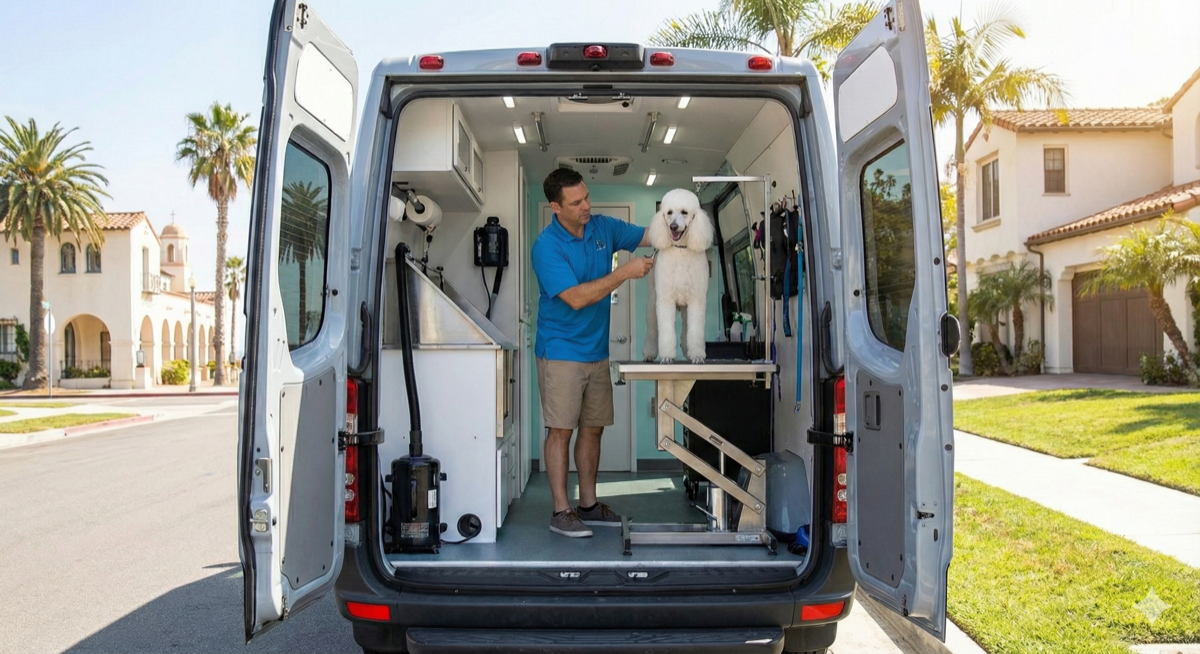
3. Mobile grooming
- Van or trailer-based grooming unit
- Travels to client locations
- Multi-jurisdiction licensing complexity
- Fewest zoning restrictions
Once you select a model, every subsequent step—zoning, permits, inspections, and taxes—follows from it.
Part 3: Illinois Business Registration (Required for Most Groomers)
Most grooming businesses in Illinois must register with the Illinois Secretary of State.
Official resource: Illinois Secretary of State Business Services | Phone: (217) 782-2201 | Toll-free: (800) 252-8980
Who must register
Always required:
- LLCs and corporations
- Sole proprietors or partnerships using an assumed business name (DBA)
- Businesses with employees
May be exempt from state registration:
- Sole proprietors using only their legal name with no employees
However, even if exempt from state registration, you still need city/municipal business licenses and must register for federal and state tax purposes.
What business registration does
Your registration:
- legally establishes your business entity with the state
- creates your business’s legal identity
- is required for tax accounts
- is needed for city and county permits
- is required for banking and insurance
Operating without proper registration means operating illegally.
Registration fees and renewal (verify current fees)
Current fees as of early 2026 (always verify at Illinois SOS Business Services):
- LLC filing: $150 initial filing
- LLC annual report: $75 (due before anniversary month of formation)
- Corporation filing: $150 minimum plus initial franchise tax ($25 minimum)
- Assumed Business Name (DBA): $120 at state level (fee varies on a 5-year cycle); county-level fees vary
- Expedited processing (optional): $100 additional (processed within 24 hours)
- Late annual report penalty: $100 fine assessed after 60 days overdue
- Name reservation (90 days): $25
Note: Fees are subject to change. Verify current amounts before filing. Sole proprietor and partnership DBAs are filed with the county clerk, not the Secretary of State.
Part 4: Taxes Groomers Must Pay in Illinois
Official resource: Illinois Department of Revenue | Phone: 1-800-732-8866 or (217) 782-3336
Register through: MyTax Illinois
1. Illinois Has a Flat Income Tax
Unlike many states with graduated brackets, Illinois uses a flat income tax rate.
Current rates (verify annually):
- Individual rate: 4.95% of net income
- Corporate rate: 7.0% plus 2.5% personal property replacement tax = 9.5% combined for C-Corporations
- Pass-through entities (S-Corps, LLCs): income passes through to individual owners at 4.95%; a 1.5% replacement tax applies to pass-through entity income
For sole proprietors, partnerships, LLCs taxed as partnerships, and S corporations, business income passes through to your personal tax return at the 4.95% flat rate.
You pay quarterly estimated taxes to both Illinois and the IRS.
2. Sales Tax on Grooming Services
Pet grooming services are generally NOT subject to Illinois sales tax.
Illinois’s Retailers’ Occupation Tax (sales tax) applies primarily to tangible personal property, not services. Grooming services fall outside the taxable base.
However, if you sell tangible goods alongside services (shampoos, collars, treats, etc.), those product sales ARE taxable:
- State base rate: 6.25%
- Local add-ons bring total to 7.0% - 11.0% depending on location
- You must register for a Retailer’s Occupation Tax (ROT) certificate if selling products
Important: Keep service revenue and product sales clearly separated in your records to ensure proper tax treatment.
3. Use Tax
Illinois imposes a Use Tax (at the same 6.25% state rate) on tangible personal property purchased outside Illinois for use within the state. This applies to equipment, supplies, or products purchased from out-of-state vendors that did not collect Illinois tax.
4. Employer Payroll Taxes (If You Have Employees)
Register through: MyTax Illinois
If you hire staff:
- State income tax withholding: 4.95% of employee wages (after exemptions)
- Unemployment insurance (SUTA): new employer rate approximately 3.35%; experienced employer rates range from 0.2% to 8.1%
- Taxable wage base for 2026: $14,250 (verify annually)
- Federal payroll taxes: Social Security, Medicare, federal withholding
- Workers’ compensation insurance: mandatory from first employee (see Part 11)
Register for unemployment insurance through the Illinois Department of Employment Security (IDES).
5. Local Taxes
- Chicago: No specific local tax on grooming services, but you must register with the Chicago Department of Finance for any applicable city taxes
- Cook County: No county-specific grooming tax
- Local sales tax add-ons: Range from 0.75% to 4.75% on top of the state 6.25% rate, but apply to tangible goods only, not services
Part 5: City Business Licensing (Highly Variable by Location)
Illinois has over 1,298 municipalities, and licensing requirements vary significantly.
Who needs city licenses
- storefront salons inside city limits
- home-based groomers inside city limits
- mobile groomers operating in city limits
Chicago (Special Case — Strict Requirements)
Official resource: City of Chicago Business Affairs and Consumer Protection (BACP) | Phone: (312) 744-6249
Chicago has the most comprehensive requirements in the state for pet grooming businesses.
Animal Care License (REQUIRED for grooming in Chicago):
- Any business that grooms, boards, breeds, trains, or provides day care for dogs or cats must obtain an Animal Care License
- License fee: $275 per location (two-year term — verify current fee)
- Requires inspection by Chicago Animal Care and Control
- Requires a City debt check (all debts to the City must be resolved)
- Apply online at chicago.gov/bacp or in person at City Hall, 121 N. LaSalle Street, Room 800
CRITICAL Chicago restriction for home-based groomers:
Chicago’s Municipal Code lists “animal care uses” as a PROHIBITED home occupation. This means you cannot legally operate a pet grooming business from your home in Chicago. You must operate from a properly zoned commercial location or as a mobile business.
Chicago facility requirements:
- Potable water for animals at all times
- Adequate nutrition appropriate for species
- Records of owner name, address, phone, and emergency contact for every animal in care
- Interior layout plans may be required as part of zoning review
Springfield
Springfield does not have a dedicated pet grooming license. A general business license from the city is typically required. Contact the City of Springfield for specific requirements.
Rockford
Contact the City of Rockford Business Licensing division for local requirements. A general business license or registration is typically required.
Naperville
Naperville requires businesses to comply with local zoning and obtain applicable permits. Contact City of Naperville for specifics.
Aurora
General business registration required. Contact the City of Aurora for specific requirements.
Joliet
The City of Joliet requires business licenses for operations within city limits. Contact Joliet Business Services at (815) 724-3905 for pet grooming-specific requirements.
Peoria
The City of Peoria has no standard business license requirement but does license specific business types. Contact the city to confirm whether pet grooming requires a specific local license.
General pattern for Illinois municipalities
Most Illinois municipalities outside Chicago have lighter licensing requirements:
- General business license or registration (often $50-$250 annually)
- Zoning verification or permit
- Building/occupancy inspection (if operating from a commercial space)
- No pet-grooming-specific municipal licenses (that level of specificity is unique to Chicago)
Action step: Contact your specific city clerk or revenue office before opening.
Part 6: Illinois Animal Welfare Act — Does It Cover Grooming?
Official resource: Illinois Department of Agriculture — Animal Welfare | Phone: (217) 782-4944
The Illinois Animal Welfare Act (225 ILCS 605) is administered by the Illinois Department of Agriculture, Bureau of Animal Health and Welfare.
Key finding: Grooming-only facilities are NOT covered
The Act requires licenses for: pet shop operators, dog dealers, kennel operators, cat/dog breeders, animal control facilities, animal shelters, day care operators, and guard dog services.
A “kennel operator” is defined as someone who maintains animals for “boarding, training or similar purposes” — grooming alone (where animals are present only during the service appointment and not kept overnight) does not meet this definition.
When state licensing IS required
If your grooming business also offers:
- Boarding: Requires a kennel operator license
- Daycare: Requires a day care operator license
- Retail pet sales: Requires a pet shop operator license
License fee (if applicable): $350 per license type
- Apply at agr.illinois.gov
- Facilities are subject to Department inspections
- Must comply with sanitation and housing standards
County animal control
Individual counties enforce animal control ordinances that may include:
- limits on number of animals at a premises
- noise ordinances
- waste disposal requirements
- rabies vaccination requirements for animals in commercial care
These vary significantly by county. Check with your county’s animal control division.
Part 7: County Examples (Requirements Vary Significantly)
Cook County
Official resource: Cook County Building & Zoning | Phone: (312) 603-0500
Cook County includes Chicago and many suburbs. For unincorporated areas:
- Home occupation requires submitting an affidavit to the Zoning Administrator
- Business occupancy application fee: $250 payable to Cook County Collector
- Email: info.BNZ@cookcountyil.gov
For incorporated areas (suburbs), requirements are set by the individual municipality.
Action step: Determine whether your location is in an incorporated municipality or unincorporated Cook County, then contact the appropriate authority.
DuPage County
DuPage County Code Chapter 5 governs animal regulations. Business licensing is handled at the municipal level (Naperville, Wheaton, Downers Grove, etc.).
Action step: Contact your specific municipality within DuPage County for business license and zoning requirements.
Lake County
Official resource: Lake County Home Occupations
Lake County allows home occupations with restrictions:
- Pet limits: up to 4 dogs and 4 cats over 6 months old per residence (may limit grooming volume)
- Home occupation rules apply
Action step: Contact Lake County Planning & Zoning for current requirements specific to grooming operations.
Will County
Business licensing is primarily at the municipal level (Joliet, Plainfield, Bolingbrook, etc.).
- Joliet Business Services: (815) 724-3905
Action step: Contact your specific municipality within Will County.
Kane County
Kane County Code Chapter 5 covers Animal Control Ordinance. Business licensing is primarily at the municipal level (Aurora, Elgin, Geneva, etc.).
Action step: Contact your specific municipality within Kane County for requirements.
Part 8: Zoning (The Requirement That Overrides Everything)
Zoning approval is mandatory before opening any grooming business.
Storefront zoning
You must confirm that:
- pet grooming is an allowed or conditional use in your zoning district
- parking requirements can be met
- signage is permitted
- noise and odor standards can be maintained
- wastewater disposal is approved
In Chicago specifically:
- Pet grooming (without boarding) is classified as an “Animal Service” use
- Allowed by right in B and C commercial districts (zones B1, B2, B3, C1, C2, C3)
- May require special use permits in certain mixed-use zones
- Refer to the Chicago Business Zoning Guide
Contact your city or county planning department for zoning verification.
Home-based zoning (Home Occupation Rules)
Chicago: PROHIBITED. Animal care uses are explicitly listed as prohibited home occupations under Chicago’s Municipal Code. No variance or workaround exists.
Suburban municipalities (general pattern):
Home occupation regulations vary by jurisdiction but often limit:
- must be secondary to residential use
- limited floor area (often 10-25% of home or 200-500 sq ft)
- limited customer/patron visits (often 2-4 at a time)
- limited or no non-resident employees
- no exterior signage or minimal signage
- no noise, odor, or traffic disruption
- may require home occupation permit
Cook County (unincorporated areas):
- Home occupation requires submitting an affidavit to the Zoning Administrator
- Business occupancy application fee: $250
Lake County:
- Allows home occupations with restrictions
- Limits of 4 dogs and 4 cats per residence may affect grooming volume
Schaumburg (representative suburban example):
- Home-based businesses involving animal care are inspected at least once per year
- Home occupation must be practiced by a family member residing on the premises
Mobile grooming zoning
Mobile grooming typically has fewer zoning restrictions since the business operates from a vehicle. However:
- the vehicle may be subject to commercial vehicle parking restrictions in residential zones
- some municipalities restrict overnight parking of commercial vehicles in residential areas
- you typically need a business license from every municipality where you operate
- check local ordinances on commercial vehicle size limits in residential zones
Part 9: Facility, Sanitation, and Wastewater Requirements
Facility standards
Illinois does not have grooming-specific state sanitation codes. However, grooming businesses are expected to:
- maintain clean and sanitary equipment
- monitor animal health during services
- practice safe handling
- maintain vaccination records for animals in care
- have emergency veterinary contact information available
Chicago’s Animal Care License imposes additional specific facility standards (see Part 5).
Local health departments may conduct inspections, and general building codes apply (fire safety, egress, electrical, plumbing).
Building code requirements
- Commercial spaces require a Certificate of Occupancy from the local building department
- Renovation for grooming use may require building permits
- Must comply with ADA accessibility requirements for customer-facing areas
- Adequate ventilation, drainage, non-slip flooring recommended
- Commercial plumbing (tub drains, floor drains) may require permits
Wastewater
Official resources:
If connected to municipal sewer: Generally no special permit needed for standard grooming wastewater. Hair traps and lint screens are recommended to prevent clogging.
If using a private sewage disposal system (septic):
- Regulated by the Illinois Department of Public Health and local health agencies
- Systems discharging less than 1,500 gallons/day to ground surface require IDPH approval
- Hair and pet waste should be trapped before entering the system
- Do NOT discharge chemicals, dyes, or hazardous products into private sewage systems
Home-based groomers on septic
If your home uses a septic system:
- higher wastewater volumes from grooming may overwhelm residential capacity
- chemical content (shampoos, disinfectants) can damage septic systems
- contact your county health department before starting operations
- you may need a septic system evaluation or upgrade
Mobile groomers
- wastewater must be captured in onboard holding tanks
- disposed of at approved dump stations or sanitary sewer connections
- never dumped into storm drains, streets, yards, or natural water bodies
- illegal wastewater disposal can result in fines and business closure
Action step: Before starting operations, identify and map approved wastewater disposal locations.
Part 10: Animal Welfare and Operating Standards
Legal framework: Illinois Animal Welfare Act (225 ILCS 605) and Humane Care for Animals Act (510 ILCS 70)
While Illinois does not have grooming-specific animal care regulations, groomers are subject to:
- Humane Care for Animals Act — prohibits cruel treatment, neglect, and abuse
- no unattended animals in unsafe conditions
- proper temperature control (heat stress prevention)
- secure containment
- immediate response to injuries or illness
- vaccination verification (especially rabies)
Best practice: Document handling procedures and incident response protocols to demonstrate compliance with animal welfare standards.
Professional grooming salon software with digital compliance tracking and vaccination management helps ensure you meet animal welfare standards without manual checklists, keeping documentation audit-ready.
Part 11: Insurance and Workers’ Compensation
Insurance (Not Optional in Practice)
Most Illinois groomers need:
- General liability insurance — typical coverage: $1-2 million; average cost: $27-64/month
- Care, custody, and control (CCC) coverage (also called bailee coverage) — covers injury to animals in your care; standard general liability often excludes this
- Commercial property insurance — covers equipment and inventory
- Commercial auto insurance (mobile groomers) — required by law for commercial vehicles; average cost: ~$147/month
- Workers’ compensation (if employees) — mandatory in Illinois
Typical liability coverage: $1-2 million.
A Business Owner’s Policy (BOP) bundles general liability and commercial property insurance, typically ~$80/month for pet groomers.
Workers’ Compensation (MANDATORY in Illinois)
Official resource: Illinois Workers’ Compensation Commission (IWCC) | Phone: (312) 814-6500 | Toll-free: (866) 352-3033
Workers’ compensation insurance is mandatory in Illinois for all employers from the very first employee — there is no minimum employee count threshold.
Key details:
- Governed by the Illinois Workers’ Compensation Act (820 ILCS 305)
- Applies to full-time, part-time, and seasonal employees
- Sole proprietors with no employees may exempt themselves
- Business partners, corporate officers, and LLC members may exempt themselves
Penalties for non-compliance:
- $500/day fine for knowing and willful failure to obtain coverage (minimum $10,000)
- Injured employees may sue in civil court with unlimited damages
- Corporate officers can be held personally liable
How to obtain: Purchase from a private insurance carrier or apply to the Illinois Assigned Risk Pool if unable to obtain coverage in the private market.
Part 12: Home-Based vs Mobile vs Storefront — Key Differences
Home-based
- lowest overhead ($2,000-$15,000 startup)
- prohibited in Chicago
- most zoning-sensitive in suburbs
- client visit and signage limitations
- neighbor complaint risk
- homeowner’s policy does NOT cover business use
Mobile
- moderate startup cost ($20,000-$50,000+)
- fewest zoning restrictions
- multi-jurisdiction licensing (each city you serve)
- commercial auto insurance required by law
- flexible location, higher operating costs
Storefront
- highest startup cost ($50,000-$100,000+)
- clearest zoning path in commercial districts
- easier client access and walk-in traffic
- Chicago Animal Care License required ($275/two years)
- most straightforward permitting
Part 13: Example — Operating in Chicago
Chicago requires the most layers of compliance in Illinois:
- Illinois business registration (Secretary of State)
- Federal EIN
- Illinois tax registration (MyTax Illinois)
- Chicago Animal Care License ($275/two years)
- Zoning verification (B/C commercial districts)
- Facility inspection by Chicago Animal Care and Control
- Certificate of Occupancy
- Proof of insurance
- Workers’ compensation insurance (if employees)
- City of Chicago Department of Finance registration
Missing any layer can delay opening or result in closure and penalties.
Cost example (storefront in Chicago):
- LLC registration: $150
- Annual report: $75
- Chicago Animal Care License: $275 (two-year term)
- Insurance: $500-1,500 annually
- Workers’ comp: varies by payroll
- Zoning/permits: varies
- Build-out/renovation: varies significantly
Part 14: Practical Compliance Checklist
Universal (all groomers)
- Illinois business registration (Secretary of State)
- Federal EIN (IRS)
- Illinois tax registration (MyTax Illinois)
- Quarterly estimated tax payment system (state and federal)
- Business banking account
- Business insurance (general liability + CCC coverage)
- Workers’ compensation insurance (if any employees)
Storefront
- Zoning approval confirmed
- City business license (varies by municipality)
- Chicago Animal Care License (if in Chicago)
- Building permits (if building out space)
- Certificate of Occupancy
- Wastewater/sewer connection confirmed
- Facility inspection passed (Chicago and some suburbs)
- Proof of insurance submitted
Home-based
- Confirm not in Chicago (prohibited for animal care)
- Home occupation zoning compliance verified with municipality
- Home occupation permit obtained (if required)
- Septic system approval (if on private sewage — contact county health dept)
- Client visit and signage restrictions understood
- Parking regulations met
- Neighbor notification (if required)
- Separate business insurance (homeowner’s policy does NOT cover)
Mobile
- Commercial vehicle registration and insurance
- Wastewater holding tank and disposal plan
- City licenses for all jurisdictions where you operate
- Commercial vehicle parking compliance at home base
- Proof of insurance
Part 15: Common Mistakes and How to Avoid Them
Mistake 1: Operating a home grooming business in Chicago
Chicago explicitly prohibits animal care as a home occupation. This is not a gray area — it is a prohibited use under the Municipal Code.
Solution: If you want to groom in Chicago, operate from a properly zoned commercial location or as a mobile business.
Mistake 2: Skipping workers’ compensation insurance
Illinois mandates workers’ comp from the very first employee — no exceptions for small businesses. Penalties include $500/day fines (minimum $10,000) and personal liability for corporate officers.
Solution: Obtain workers’ comp coverage before hiring your first employee, even part-time or seasonal staff.
Mistake 3: Assuming no sales tax on everything
While grooming services are not taxable, product sales are. Selling shampoos, treats, collars, or accessories without collecting sales tax creates tax liability.
Solution: Register for a Retailer’s Occupation Tax certificate if selling any products. Keep service and product revenue clearly separated.
Mistake 4: Ignoring city-specific licensing
Illinois has over 1,298 municipalities, each with potentially different requirements. Mobile groomers operating across city lines without checking each city’s requirements risk penalties.
Solution: Contact each city where you regularly operate to confirm requirements.
Mistake 5: Not getting zoning approval first
Signing a lease or starting a home-based operation without zoning approval can result in:
- lease forfeiture
- cease operations orders
- inability to open
Solution: Get written zoning approval before signing leases or starting build-out.
Mistake 6: Relying on homeowner’s insurance for business coverage
Homeowner’s policies do not cover business activities. If a pet is injured during grooming at your home, your personal policy will deny the claim.
Solution: Obtain separate business insurance with CCC/bailee coverage specifically for grooming operations.
Part 16: Licensing Timeline (How Long Does This Take?)
Important: These are general estimates. Actual timelines vary significantly by jurisdiction. Always contact the relevant permitting authorities for current processing times.
Realistic timeline from decision to opening:
Storefront: 3-6 months
- Business registration: 1-2 weeks
- Zoning approval: 2-6 weeks
- Build-out and permits: 4-12 weeks
- Chicago Animal Care License (incl. inspection): 4-8 weeks
- Insurance procurement: 1-2 weeks
- Final approvals: 1-2 weeks
Home-based: 1-3 months
- Business registration: 1-2 weeks
- Zoning/home occupation approval: 2-4 weeks
- Septic evaluation (if applicable): 2-4 weeks
- Insurance procurement: 1-2 weeks
- Setup and equipment: 1-2 weeks
Mobile: 3-5 months
- Business registration: 1-2 weeks
- Vehicle purchase and build-out: 4-12 weeks
- City licenses: 2-4 weeks per jurisdiction
- Insurance and permits: 1-2 weeks
- Marketing/soft launch: 2-4 weeks
Critical path items that cause delays:
- Chicago Animal Care License inspection scheduling — can extend timeline significantly
- Building permits and inspections — varies by city workload
- Vehicle build-out — custom van conversions take time
- Zoning variances or conditional use permits — add 2-4 months
Action step: Contact each relevant permitting authority at the start of your planning process to ask for current typical processing times.
Part 17: How to Verify Your Specific Requirements
Regulations change frequently and vary by jurisdiction. Use this checklist to verify current requirements for your specific situation:
State-level verification
- Business registration: Confirm current fees and filing requirements at Illinois Secretary of State | (217) 782-2201
- Tax requirements: Verify current tax rates and filing requirements at Illinois Department of Revenue | 1-800-732-8866
- Animal Welfare Act: Confirm whether your services require a state license at Illinois Dept. of Agriculture | (217) 782-4944
County-level verification
- Zoning approval: Contact your county planning/zoning department to confirm:
- Whether grooming is allowed in your proposed location
- Home occupation rules (if home-based)
- Parking, signage, and operational restrictions
- Animal control: Contact your county animal control to confirm:
- Animal count limits at your premises
- Noise and waste disposal requirements
- Septic/wastewater (if not on municipal sewer): Contact your county health department to confirm:
- Whether your existing septic system can handle commercial grooming wastewater
- What upgrades or permits are required
City-level verification
- City business license: Contact your city clerk or revenue office to confirm:
- Whether your city requires a business license
- Current fees and filing requirements
- Renewal schedule
- Chicago Animal Care License: If in Chicago, apply at chicago.gov/bacp | (312) 744-6249
- City zoning: Verify zoning with city planning department
- Multiple cities (mobile groomers): Verify requirements for each city where you’ll regularly operate
Insurance verification
- Contact commercial insurance providers to confirm required coverage types and amounts
- Obtain workers’ compensation insurance before hiring any employees
- Verify with city/county whether proof of insurance is required for permits
Professional assistance
Consider consulting:
- Attorney: For business structure, contracts, and liability issues
- Accountant/CPA: For tax planning, especially multi-jurisdiction issues
- Insurance agent: For appropriate coverage types and amounts (especially CCC/bailee coverage)
Part 18: Resources and Contacts
State-level
Illinois Secretary of State — Business Services
- Website: ilsos.gov/services/business.html
- Phone: (217) 782-2201 | Toll-free: (800) 252-8980
- Address: Department of Business Services, 207 State House, Springfield, IL 62706
- Services: Business registration, annual reports, forms
- Online filing
Illinois Department of Revenue
- Website: tax.illinois.gov
- Phone: 1-800-732-8866 or (217) 782-3336
- Central Registration Division: (217) 785-3707 / REV.CRD@illinois.gov
- MyTax Illinois — online registration and filing
- Business registration info
Illinois Department of Agriculture — Bureau of Animal Health & Welfare
- Website: agr.illinois.gov/animals/animalhealth/animal-welfare.html
- Phone: (217) 782-4944
- Email: AGR.Premises@Illinois.gov
- Address: P.O. Box 19281, State Fairgrounds, Springfield, IL 62794-9281
- License application
Illinois Department of Employment Security (IDES)
- Website: ides.illinois.gov
- Employer hotline: 1-800-247-4984
- Employer resources
Illinois Workers’ Compensation Commission (IWCC)
- Website: iwcc.illinois.gov
- Chicago: (312) 814-6500 | Toll-free: (866) 352-3033
- Email: wcc.infoquestions@illinois.gov
- Insurance requirements
Illinois Department of Labor
- Website: labor.illinois.gov
- Springfield: (217) 782-6206
- Chicago: (312) 793-2800
Illinois Environmental Protection Agency
- Website: epa.illinois.gov
- Wastewater permits
Illinois Department of Public Health
County contacts
Cook County Building & Zoning
- Website: cookcountyil.gov/service/building-and-zoning-business-occupancy
- Phone: (312) 603-0500
- Email: info.BNZ@cookcountyil.gov
Lake County Planning & Zoning
Will County — Joliet Business Services
- Phone: (815) 724-3905
DuPage County
- Contact specific municipality for business licensing
Kane County
- Contact specific municipality for business licensing
City contacts
City of Chicago — Business Affairs and Consumer Protection (BACP)
- Website: chicago.gov/bacp
- Phone: (312) 744-6249
- Address: City Hall, 121 N. LaSalle Street, Room 800, Chicago, IL 60602
- Animal Care License
- Home-based business info
City of Joliet
- Business Services: (815) 724-3905
City of Naperville
- Website: naperville.il.us
City of Springfield, Rockford, Aurora, Peoria
- Contact respective city offices for current requirements
Industry organizations
Illinois Professional Pet Groomers Association (IPPGA)
- Website: illinoisprofessionalpetgroomers.org
- Standards and guidelines for professional groomers
Federal
IRS — Employer Identification Number
- Website: irs.gov/businesses/small-businesses-self-employed/get-an-employer-identification-number
- Online application: free, instant (Monday-Friday, 7am-10pm ET)
- Fax: 855-641-6935 (Form SS-4)
Final Reality Check
Illinois makes it relatively easy to start grooming—there’s no professional license barrier.
But Illinois also makes it easy to accidentally operate out of compliance.
There is no groomer license—but there are:
- business registration requirements
- flat income taxes (4.95% individual, 9.5% corporate)
- sales tax on product sales (7.0%-11.0% depending on location)
- city business licenses (varies by municipality — confirm locally)
- Chicago Animal Care License ($275/two years with inspection)
- Chicago prohibition on home-based animal care businesses
- zoning approval (verify before signing leases)
- mandatory workers’ compensation insurance (from first employee)
- facility standards and animal welfare laws
If you approach setup in order—business registration → tax setup → zoning approval → permits → inspections → insurance—you avoid expensive corrections later.
Compliance protects:
- your business from closure and penalties
- your clients from liability and quality issues
- the animals in your care
And it keeps you operating legally and sustainably.
Take the Next Step
Once you’ve navigated Illinois’s licensing requirements and are ready to operate, professional grooming salon software built for Illinois groomers helps you manage the operational side—scheduling, client records, digital agreements, and compliance tracking—so you can focus on grooming instead of paperwork.
Start your free trial today and see how Packyard handles vaccination tracking, digital waivers, appointment management, and client communication in one platform.
Critical Reminder: Verify Everything Locally
This guide provides general framework only. Requirements, fees, rates, and procedures change frequently and vary significantly by jurisdiction.
Before making any business decisions:
- Contact the Illinois Secretary of State for current business registration fees and requirements
- Contact the Illinois Department of Revenue for current tax rates and thresholds
- Contact the Illinois Department of Agriculture if you plan to offer boarding, daycare, or pet sales
- Contact your specific city for business license and zoning requirements
- Contact Chicago BACP if operating in Chicago for Animal Care License requirements
- Contact your county planning/zoning department for zoning verification
- Obtain workers’ compensation insurance before hiring any employees
- Verify all information at the official sources linked in Part 18
Do not rely solely on this guide. Use it as a starting point for your research, then verify every detail with the relevant authorities before proceeding.
This article is informational and not legal advice. Always confirm requirements with your city, county, the Illinois Secretary of State, and the Illinois Department of Revenue before opening. Regulations, fees, and requirements change frequently—verify current information with official sources.