· Knowledge Base · 9 min read
How to Start a Dog Grooming Business: Complete Guide
How to start a dog grooming business from scratch. Covers startup costs, profit margins, licensing, equipment, and operational systems.
Is a Dog Grooming Business Profitable
It’s 6am on a Monday. You’re driving to a job you’ve outgrown, doing mental math on whether grooming dogs could actually pay the bills. The answer depends on your business model, your location, and how well you protect your calendar from no-shows and cancellations.
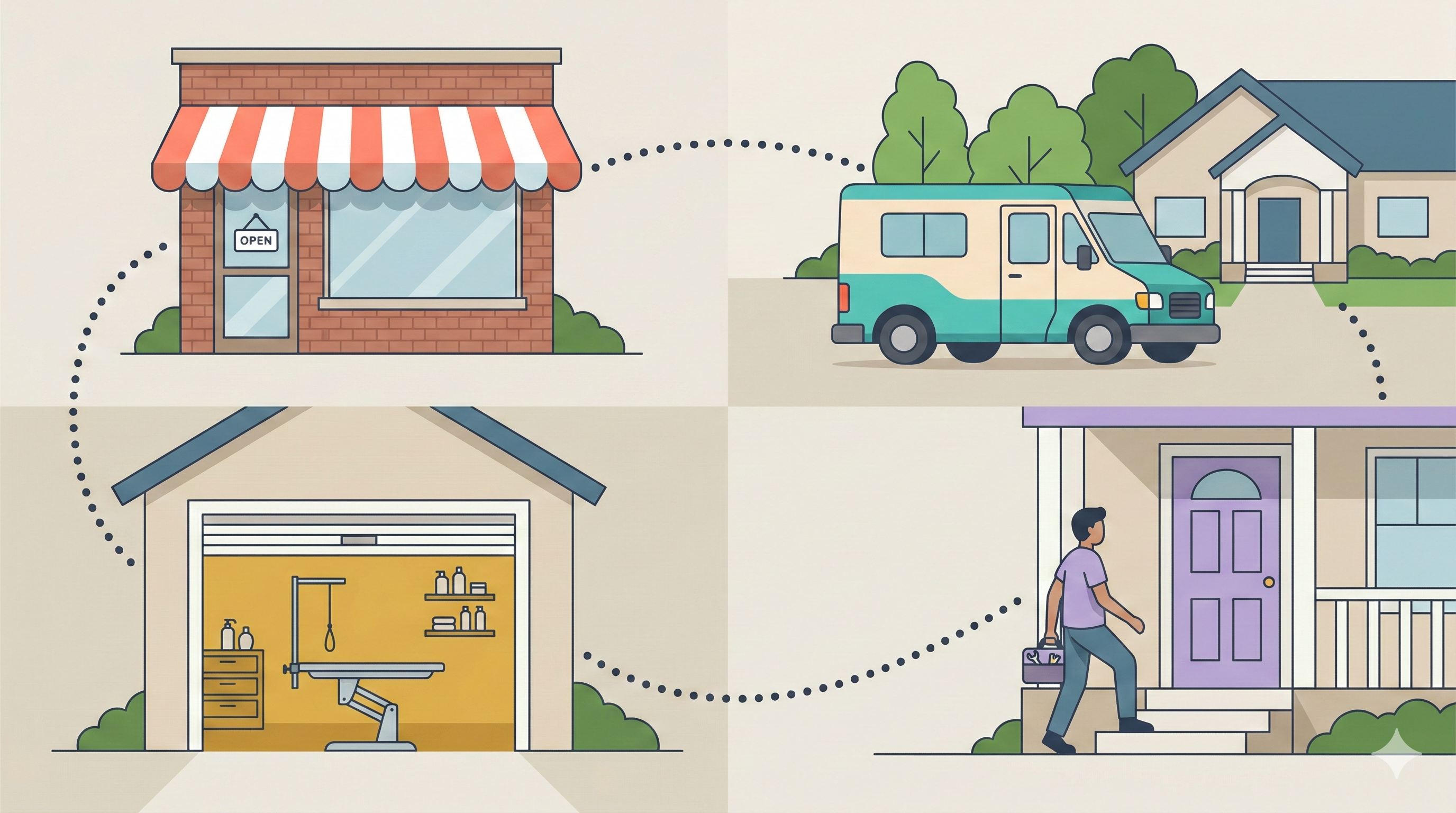
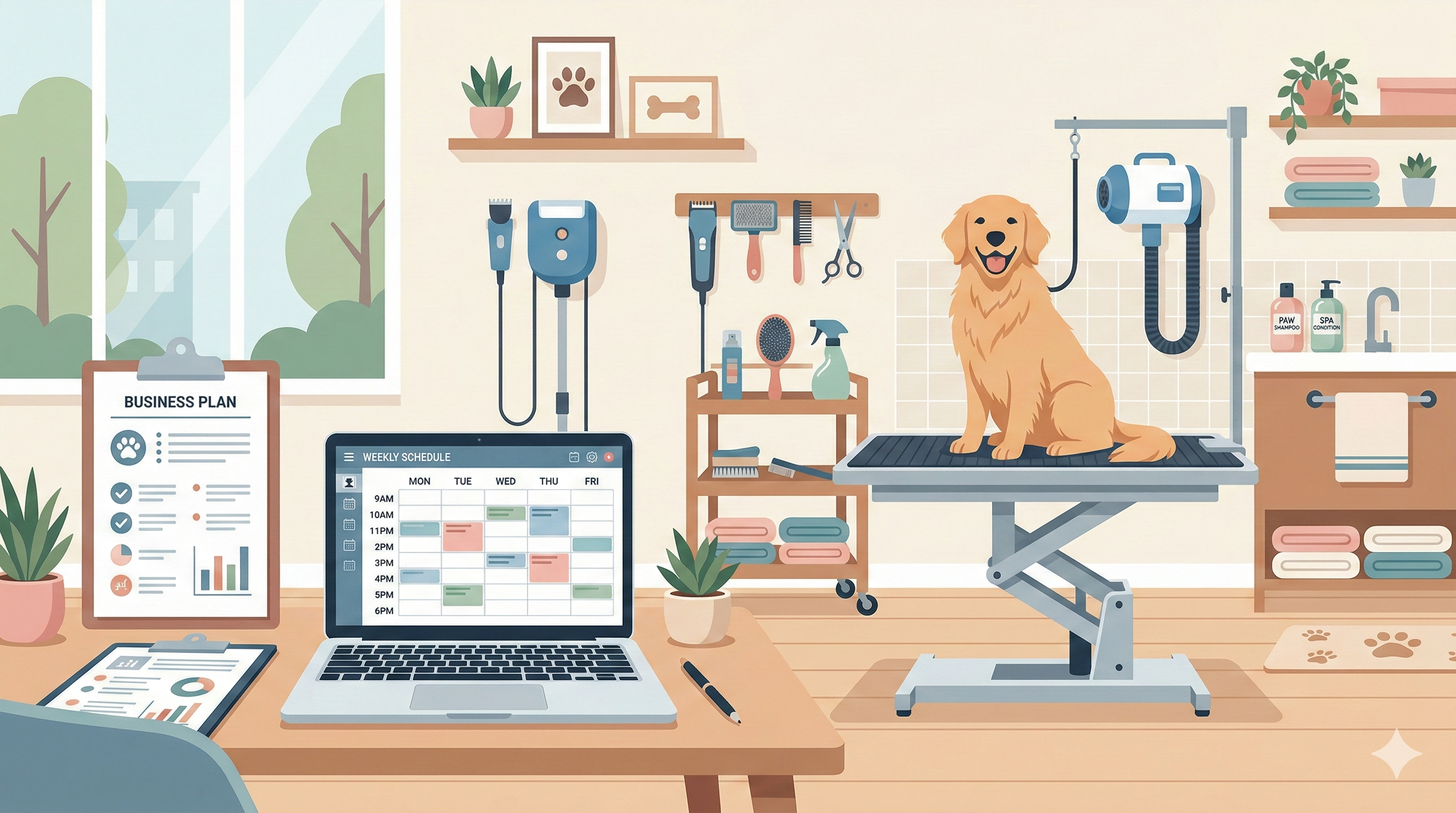
Starting a dog grooming business involves professional training or certification, acquiring specialized equipment like tables, shears, dryers, and tubs, and securing the right licenses and liability insurance. From there, you’ll define your business model—mobile, salon, or home-based—set competitive pricing, and build a local brand through social media, a website, and relationships with local vets.
How Much Do Dog Groomers Make
Employee groomers typically earn $25,000–$50,000 annually, depending on region and commission structure. Business owners have a higher ceiling—$60,000–$100,000+ is achievable once established—though income fluctuates, especially in year one.
The gap between employee and owner earnings comes down to overhead. As an owner, you keep more per groom but absorb costs employees never see: rent, supplies, insurance, software, marketing.
Average Profit Margins for Grooming Salons
Profit margin is what remains after subtracting all expenses from revenue. Grooming businesses typically run 10–20% net profit margins once established. Home-based and mobile operations often hit higher margins because overhead stays lower.
Here’s the math: a salon grossing $150,000 annually at 15% margin nets $22,500 in profit. That same revenue at 20% margin nets $30,000. The difference often comes from operational efficiency—fewer no-shows, tighter scheduling, less time chasing payments.
What Affects Grooming Business Profitability
- Location and local demand: Urban areas support higher prices but come with higher rent. Suburban markets often offer better margins.
- Pricing strategy: Underpricing is the most common mistake new groomers make.
- No-show and cancellation rates: A 10% no-show rate on $100,000 revenue means $10,000 that never hits your account.
- Rebooking and retention: Clients who rebook before leaving are worth significantly more over time than one-time visitors.
- Operational efficiency: Every minute spent on manual scheduling or chasing confirmations is a minute not spent grooming.
How Much Does It Cost to Start a Dog Grooming Business
Startup costs range from $2,000 for a basic home setup to $50,000+ for a fully equipped storefront. Your business model determines your investment.
Home-Based Dog Grooming Startup Costs
Home-based grooming offers the lowest barrier to entry. Expect to invest $2,000–$10,000 depending on existing equipment:
- Grooming table with arm and loop: $200–$500
- Professional clippers and blade sets: $300–$600
- Shears (straight, curved, thinning): $150–$400
- High-velocity dryer: $200–$400
- Bathing tub or conversion: $200–$1,000
- Initial product inventory: $200–$500
Zoning restrictions may limit home-based operations in some areas. Check with your local planning department before investing.
Mobile Dog Grooming Business Startup Costs
Mobile grooming requires a larger upfront investment but eliminates rent in a market worth $500 million annually. Budget $40,000–$100,000 for a fully equipped van or trailer:
- Vehicle purchase or conversion: $30,000–$80,000 new, $15,000–$40,000 used
- Equipment installation: $5,000–$15,000
- Branding and vehicle wrap: $2,000–$5,000
- Licensing and insurance: $1,000–$3,000
Ongoing costs include fuel ($300–$600/month), vehicle maintenance, and higher insurance premiums than stationary operations.
Storefront Grooming Salon Startup Costs
Storefronts offer the most scalability but require the largest investment. Plan for $20,000–$75,000:
| Expense Category | Typical Range |
|---|---|
| Lease deposit and first months | $3,000–$10,000 |
| Build-out and plumbing | $5,000–$25,000 |
| Equipment and fixtures | $8,000–$20,000 |
| Signage and branding | $1,000–$5,000 |
| Initial inventory | $1,000–$3,000 |
| Licenses and permits | $500–$2,000 |
Many successful salon owners started home-based or mobile, building clientele before signing a lease.
Ongoing Monthly Operating Expenses
Monthly costs vary dramatically by model:
| Expense | Home-Based | Mobile | Storefront |
|---|---|---|---|
| Rent/Lease | $0 | $0 | $1,000–$3,000 |
| Utilities | $50–$100 | Fuel: $300–$600 | $200–$500 |
| Insurance | $50–$100 | $100–$200 | $150–$300 |
| Supplies | $100–$300 | $100–$300 | $200–$500 |
| Software | $50–$100 | $50–$100 | $50–$150 |
Do You Need a License to Groom Dogs
No national grooming license exists in the United States. However, you’ll likely need business permits, and requirements vary by location.
State and Local Dog Grooming License Requirements
Most states don’t require a specific grooming license, though some municipalities require kennel permits or animal facility licenses. Florida, for example, has specific pet grooming regulations, while Washington State and Oregon have their own unique requirements. Your city or county clerk’s office can confirm local requirements.
The distinction matters: grooming certification demonstrates skill and is voluntary. Business licensing is a legal requirement to operate.
Business Permits and Entity Registration
Regardless of grooming-specific requirements, you’ll need standard business documentation:
- Register business name (DBA) with your state
- Form LLC or choose another entity structure
- Obtain EIN from IRS (free, takes 10 minutes online)
- Apply for local business license
- Verify zoning permits for home or mobile operations
- Register for state sales tax if applicable
Grooming Business Insurance Requirements
Insurance isn’t legally required everywhere, but operating without it is risky. A single dog bite or slip-and-fall incident could bankrupt an uninsured business.
- General liability: Covers accidents on your premises
- Professional liability (groomer’s insurance): Covers injuries to pets during grooming
- Property insurance: Covers equipment and inventory
- Workers’ compensation: Required if you hire employees
Expect to pay $500–$1,500 annually for basic coverage.
How to Choose Your Dog Grooming Business Model
Your business model affects everything: startup costs, daily schedule, income potential, and lifestyle.
Home-Based Dog Grooming Business
Home-based grooming works well for groomers testing the market or building clientele before scaling. Overhead stays minimal and there’s no commute. On the other hand, zoning restrictions, client traffic at your residence, and space limitations can create friction.
Mobile Dog Grooming Business
Mobile grooming offers convenience that clients pay 20-40% price premiums for. You control your territory and schedule. However, travel time between appointments reduces daily capacity, and vehicle breakdowns can shut down operations entirely.
Storefront Grooming Salon
Storefronts project professionalism and allow for multiple groomers, walk-in traffic, and retail sales. The tradeoff is higher fixed costs—you pay rent whether you’re booked or not.
Dog Grooming Business Equipment and Supplies Checklist
Quality equipment pays for itself through durability and efficiency. Cheap clippers that overheat mid-groom cost you time and client trust.
Essential equipment includes:
- Bathing: Stainless steel tub, sprayer attachment, professional shampoos and conditioners
- Drying: High-velocity dryer (essential), stand dryer (helpful for finishing)
- Clipping and cutting: Professional clippers, multiple blade sets, straight and curved shears, thinning shears
- Tables: Hydraulic or electric grooming table with arm and loop
- Safety: Muzzles, slip leads, first aid kit, styptic powder
Dog Grooming Certification and Training Requirements
Certification isn’t legally required in most areas, but training is practically essential. Grooming involves sharp tools, anxious animals, and breed-specific techniques that take time to master.
Training options include grooming schools (2–6 month programs, $3,000–$15,000), online courses (theory-focused, $500–$2,000), and apprenticeships (learn while earning, typically 6–18 months). Many successful groomers combine formal training with apprenticeship under an experienced mentor.
How to Set Dog Grooming Prices
Pricing determines profitability more than almost any other decision. Underpricing attracts price-sensitive clients who no-show more frequently and complain more often.
Research local competitors by calling for quotes and checking websites. Position based on value—your skill, convenience, and client experience—not on being cheapest.
Standard pricing factors include size (small, medium, large, extra-large tiers), coat type (smooth coats take less time than double coats or doodle coats), and condition (matted dogs require upcharges). Add-ons like nail grinding, teeth brushing, and deshedding treatments increase average ticket value.
How to Market Your Dog Grooming Business
Marketing doesn’t require a large budget, but it does require consistency.
Start with the fundamentals: a Google Business Profile (free and essential for local search), a simple website with services, pricing, and online booking, and social media accounts for before-and-after photos. Local partnerships with vets, pet stores, and trainers can generate referrals.
Your first clients often come from friends, family, and their networks. Ask every satisfied client for a Google review—reviews drive local search rankings more than almost any other factor.
Dog Grooming Business Software and Scheduling Systems
It’s 2pm on a Saturday. You’re elbow-deep in a matted doodle when your phone buzzes—another client asking about openings. You can’t check your calendar, can’t respond, and by the time you’re done, they’ve booked elsewhere.
This scenario repeats daily for groomers relying on manual scheduling. Software isn’t overhead—it’s infrastructure that captures revenue you’d otherwise lose.
Online Booking and Appointment Scheduling
Online booking lets clients book 24/7 without calling or texting. Rules protect your schedule: service durations, staff availability, and capacity limits prevent the double-bookings and chaos that come from manual management.
Automated Reminders and No-Show Prevention
Automated SMS reminders—24 hours and 2 hours before appointments—reduce no-shows by 30%. Confirmation tracking shows who’s confirmed versus who hasn’t responded, letting you fill gaps before they become empty slots.
One missed $80 appointment per week costs $4,160 annually. Prevention systems typically pay for themselves after a single saved appointment.
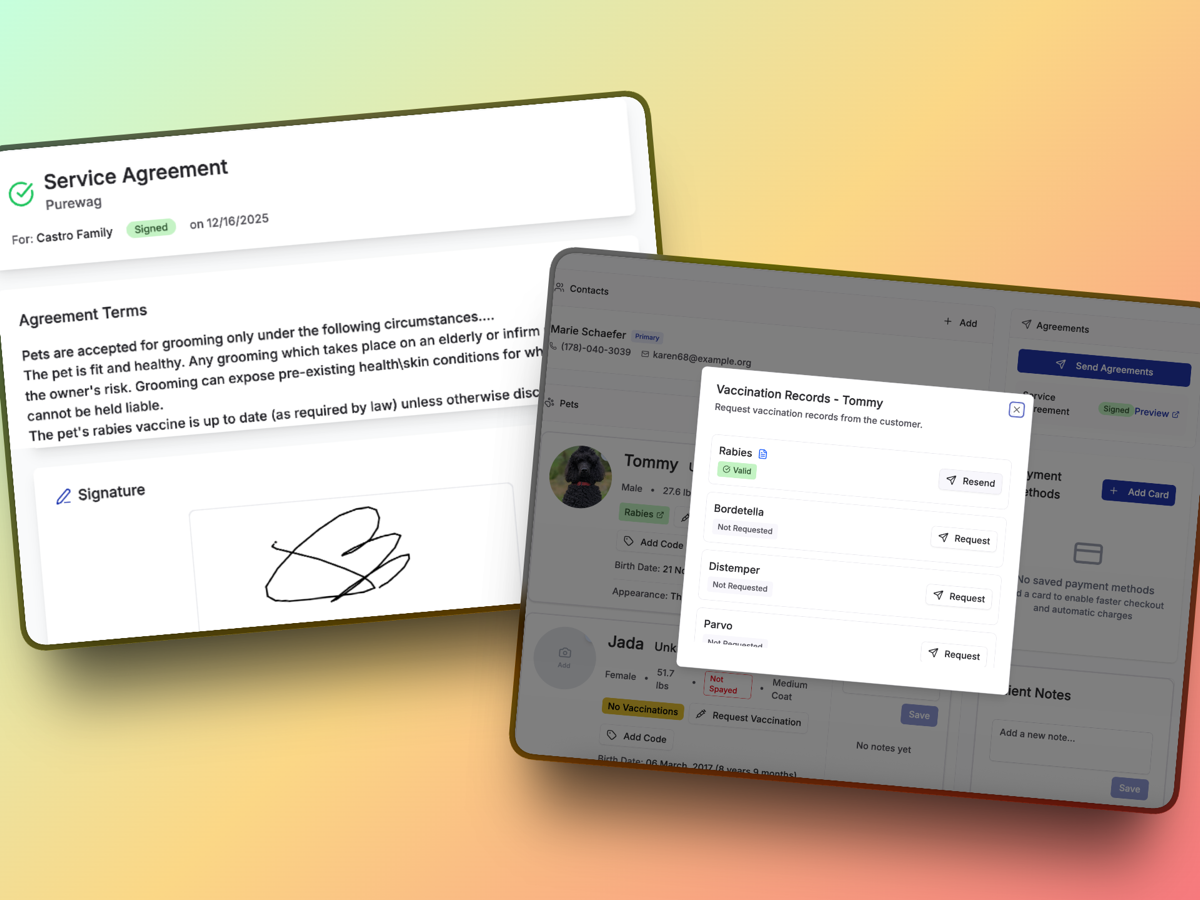
Client and Pet Record Management
Every client and pet documented in one place: breed, size, coat type, behavior flags, vaccination records, grooming notes, photos. Anyone on your team can pick up where the last groomer left off—no sticky notes, no scattered texts, no “I forgot what cut she gets.”
Payment Processing and Square Integration
Seamless checkout means services, retail, tips, and taxes process in one transaction. Native Square integration—if you already use Square—means you don’t switch payment processors or manually reconcile at day’s end.
Tip: Grooming-specific software handles service stacking, buffers, cleanup time, and multi-groomer calendars in ways generic scheduling tools can’t.
Launch Your Dog Grooming Business the Right Way
The path is clear: validate profitability, choose your model, handle legal requirements, get equipped, price your services, market to your first clients, and systematize operations from day one.
Systems—not just grooming skills—determine whether your business thrives or burns you out. Starting with the right software prevents the chaos of piecing together tools later.
Start your free trial today—Packyard is built by groomers, for groomers, and pays for itself after one saved appointment.
Frequently Asked Questions About Starting a Dog Grooming Business
How long does it take to start a dog grooming business?
Home-based or mobile operations can launch within weeks to a few months, depending on training and equipment acquisition. Storefronts typically take 3–6 months due to lease negotiation and build-out.
Can I start a dog grooming business with no grooming experience?
Yes, but training comes first. Grooming schools, online certification programs, or apprenticeships under experienced groomers provide the foundation before taking clients independently.
What are the biggest mistakes new dog grooming business owners make?
Underpricing services, failing to enforce cancellation policies, and relying on manual scheduling instead of automated systems that prevent no-shows and keep the calendar full.
How do dog groomers handle aggressive or difficult dogs?
Professional groomers use muzzles, grooming loops, and calm handling techniques. Some charge extra for difficult dogs, and declining service for safety reasons is always acceptable.
How do dog grooming businesses prevent no-shows?
Automated appointment reminders, confirmation tracking, and clear cancellation policies reduce no-shows significantly. Deposits or cards on file for new clients add accountability.